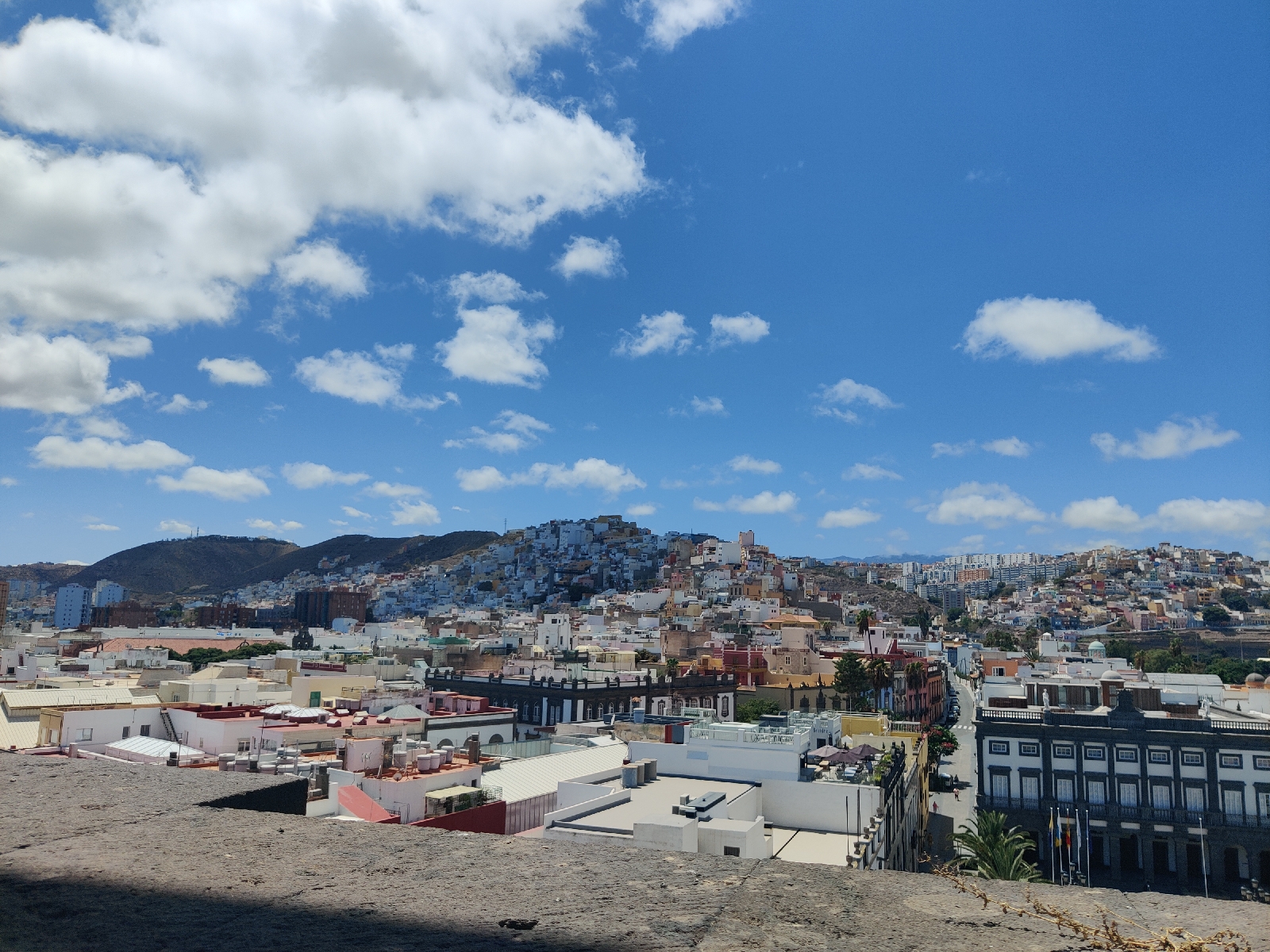
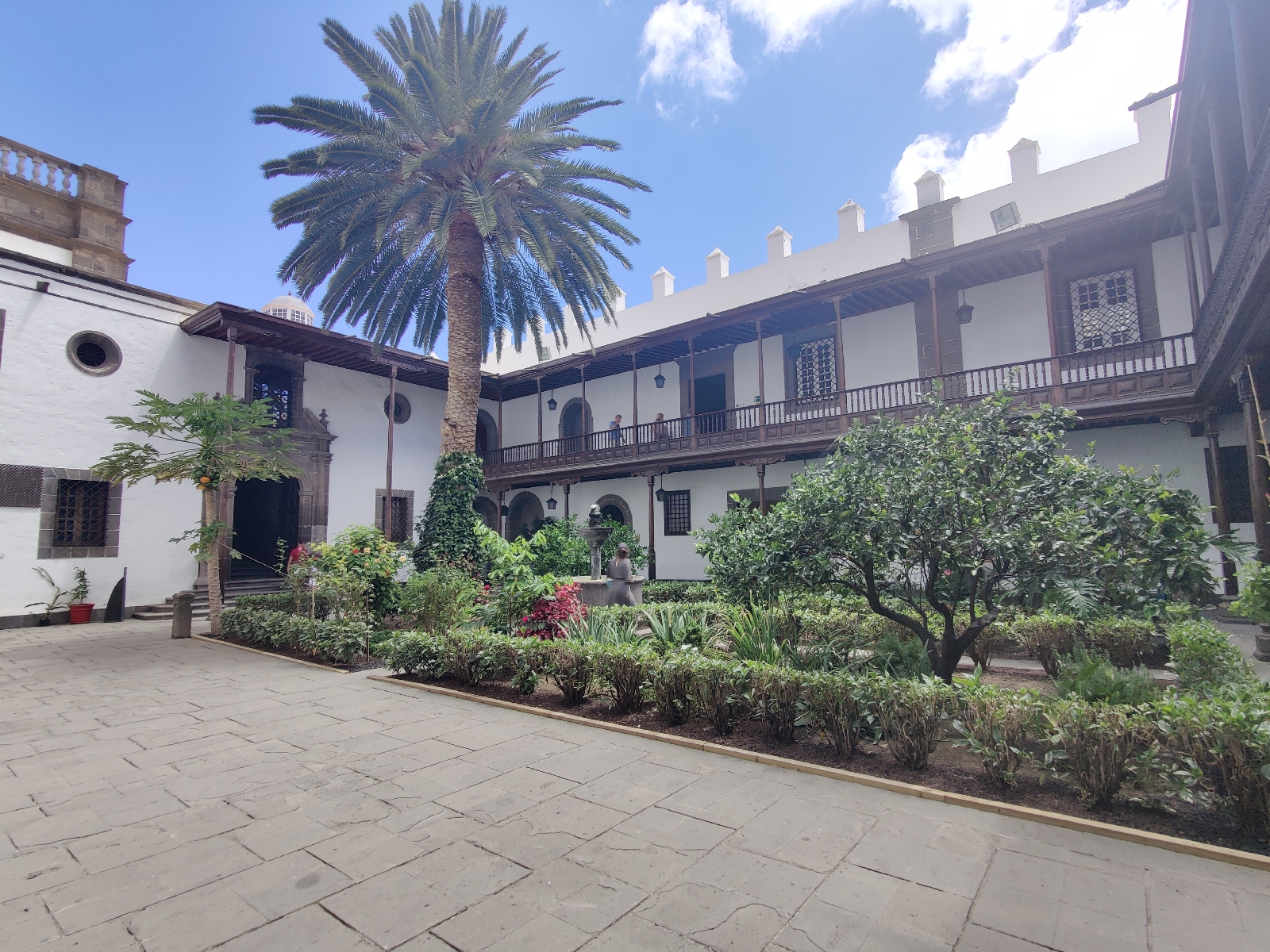
Tuesday, 31 October 2023

Update 2 from Gran Canaria

So I get back to Pasito Blanco on October 3rd. Mick was due back on the 28th (but subsequently delayed his return to 2nd November) and I really want to visit the Island of La Gomara before my Shengen days expired on 10th of November.

I had three major jobs to complete and a host of smaller ones if we were to be to get soon after Mick's arrival. Of course, as I got stuck into the jobs new ones appeared as if by magic and as it turned out I would be busy working on the boat neary every day for the next four weeks. Not for the first time, the optimistic assessment I gave to Sharon when buying Bonny, "..she's got everthing I need.." seemed so incredibly wide of the mark it's almost unbelievable. I'd spent nearly all my free time over the last 18 months working on her (and Mick has spent lots of his free time on her too) and I dread to think how much money I've spent and yet here we were with only a few weeks to go before pushing off from the Canaries and I still had a full time job of boat maintenance on my hand! And don't forget, we'd already spent a lot of time on maintenace and repairs on the passage thus far. Whatever you do, don't buy a boat!

The big jobs were: fit the new Hydrovane, clean the bottom of the boat and fit the Starlink. Others including making and fitting an additional work top in the very badly designed galley; servicing the main engine, servicing the outboard engine, adding additional solar power and re-filling the propane tank. All these and many others besides are actually buckets of individual tasks that can take ages to complete, that includes tracking down all the tools and materials and parts that are required. If stuff needs to be bought that wipes out a full day. I've actually only spent one day so far on non boat maintenance activities! That was a couple of Sundays ago when I took a walk round the coast to Malpalmas, the big resort area. 

The Hydrovane is the wind operated self steering gear. You may remember from previous posts that after repeated attempts to repair the old one that came with the boat, repeated failures finally convinced me to buy a new one. A reliable self steering system is an essential piece of kit for short handed long distance sailing. Bonny has a robust electronic self steering system as well, but relying on that over thousands of miles of ocean passage making would be foolhardy. It also consumes power, which thanks to various improvements already made or in progress, such as the new water heater, water maker, fridge and now Starlink, is becominng an increasingly precious and limited resource. Hence the need for more solar power.

Agustin was once again a life-saver with respect to the Hydrovane. Not only did he take delivery at his home address in his name and with his Canarian Tax ID - which simplified the highly complex Canarian import and customs procedure no end but he spent a day in the sweltering heat helping me remove the old gear and install the new equipment. 

On removing the old/ancient gear I discovered two things. 

Firstly, it may have been possible to dismantle it sufficiently to replace the old shaft - although in so doing during this operation, I did end up breaking an essential casting! I shied away from attempting this before because of the risks of breaking something and/or being unable to replace hidden parts such as bearings imbedded in the tube. In hindsight however, this is probably something we could have got done in Bouzas. If things had got broken in the process we would have been no worse off! Quite why we did not follow this logic through to that conclusion I don't know. I might have saved myself 4.5K that I could ill afford to spend!

The second thing I discovered was that the gear was in an even worse state than we realised. It turned out that the old shaft, in addition to having a hinge welded on to the bottom - which introduced the weaknesses that caused the repeated failiures - the shaft was also welded together midway along its length. This weld was hidden from view being inside the tube, but it too was a prime candidate for failure. 

Anyway, I've now got a new latest model Hydrovane which is both more robust and his some useful refinements built in such as gearing to cope better with different wind strengths and sea states, a more powerful vane and rudder and a remote adjustment system which avoids the neen to lean off the back of the boat to change course - particularly handy in bad weather. I've also got peace of mind. So on balance I think things have probably turned out for the best. 


The new Hydrovane has yet to be tested however. That's set for our next passage to La Gomara about 100 miles from here. If further adjustments to the set-up are needed we can make them there.

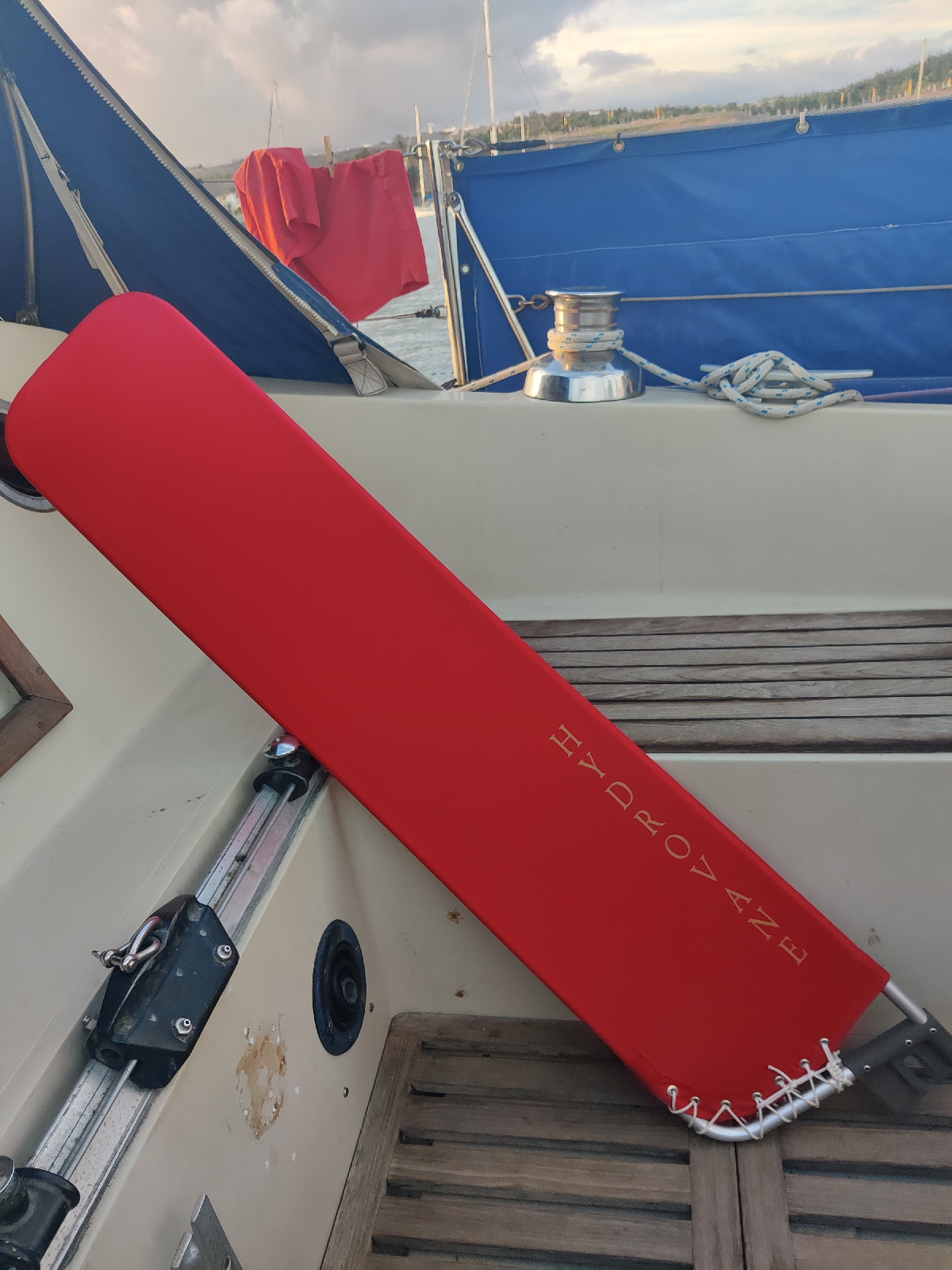
By the way one of the jobs associated with the main job of installing the new Hydrovane which turned out to be far more time consumig than I had anticipated was fitting the nylon cover to the wind vane frame. It has to be stretched over the frame and lashed tightly to it. This requires soaking it in water and then a few painstaking hours of stretching and lashing. The finished result is shown in the photo below but believe it or not, before one starts the stretching/lashing procedure, the cover only came two thirds of the way down the frame!

The next big job was cleaning the bottom of the boat. I'd reluctantly decided to incur yet further expense and have the boat lifted out of the water to do this and install the Hydrovane. The thought of dropping an essential Hydrovane component to the bottom of the marina or damaging due to the boat surging against the pontoon was two awful to contemplate. I'd also already snorkelled under the boat to examine the extent of the fouling and whilst it didn't look too bad, I was not confident that I still had the stamina to spend hours snorkelling and scraping. The two issues made the decision to haul out a fairly easy one.
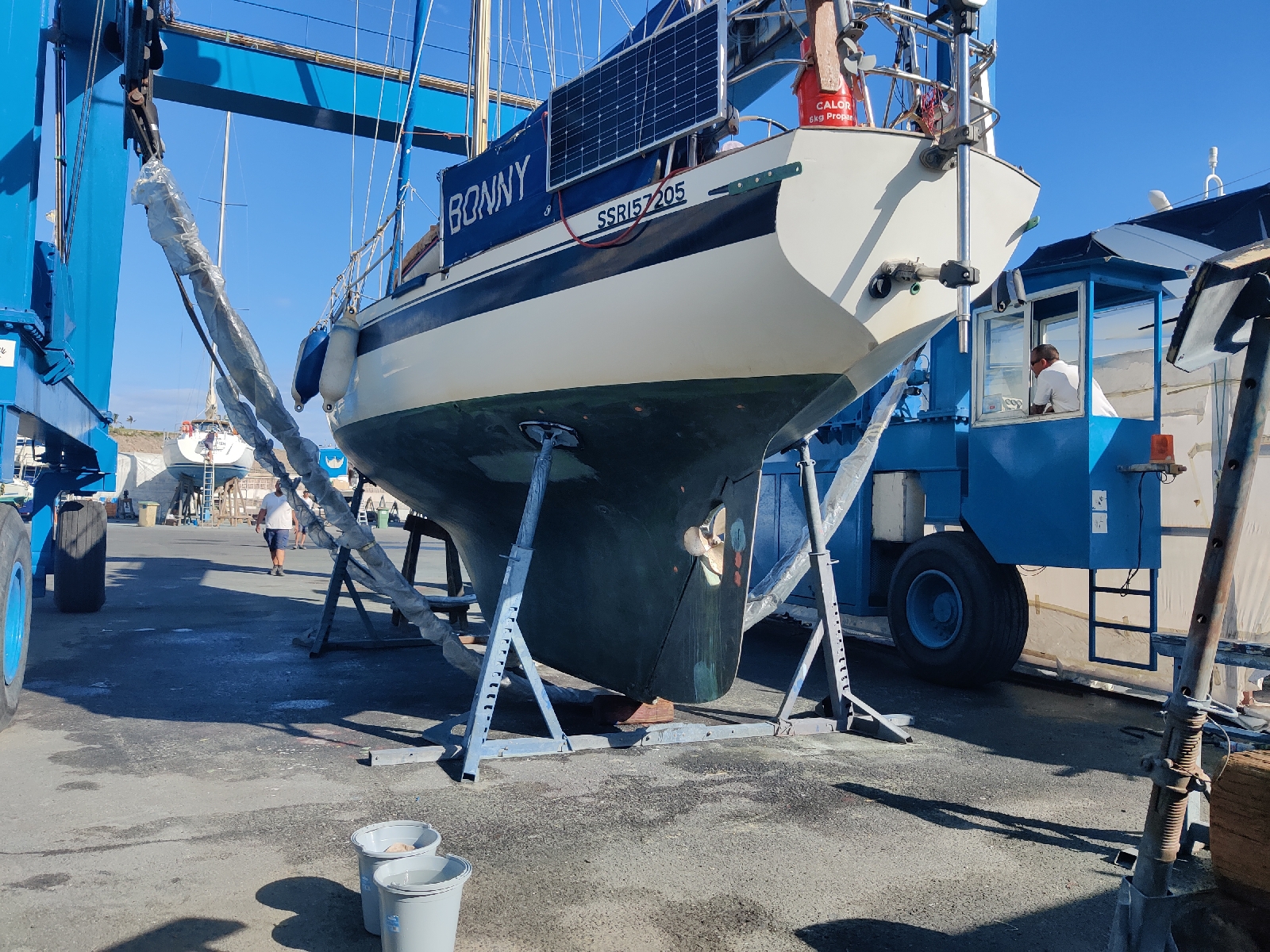

The bottom was not badly fouled but it was under attack by the local barnacle strain. 
Barnacles between the keel and rudder.

A really stubborn creature that whilst small in size is, once it has taken hold, extremely difficult to get off. I new this from my previous experience with Arctic Smoke when I left her in the Marina here for a year in 2015/16. Her bottom was completely covered by this tenacious creature and it took me days of scraping to clean it off.

Things were nowhere near as bad this time but nevertheless even with the aid of the yard's high pressure washer, it still took be the best part of a day to remove all traces of the pesky stuff. I was absolutely knacked by the time I'd finished and ached all over. It's important to get rid of all of it, not so much because small bits of it will slow the boat down, but because they provide a foundtion for more to attach and so the rate of coverage grows expodentially. The worst affected area was the propeller. It was clear on re-launch that the boat's performance under power was significantly improved.

Next up on the big jobs was the installation of Starlink. There were four main elemets to this. Designing the physical mounting infrstructure, finding the necessary compents, installing them, routing the cables, and connecting to the power supply. I thought the last of these would be the simplest - simply plug it into the boat's existing inverter (that's a box of electronics that turns 12 volts into 230/40 volts which for some bizare reason Starlink requires to run. Given the thing is designed for use by 'campers' you would think it would be a 12 volt system but oh no, 230 volts are needed. This part of the job turned out to be the most troublesome and indeed is not yet completed.

First I figured out the design for mounting the satalite dish. It needed a clear view of the sky at all times. This meant it needed to be relatively high up. It mustn't foul any of the rigging and ideally should not cast any shadow over the solar panel (Mick and I had already removed the wind generator because it was doing just that). I established a location on the port side deck where I thought a pole could be mounted which should then satisfy these requirements except that at some relative angles to the sun, a small shadow would be cast on the top solar panel. It was also too close to a mooring cleat to be ideal but I couldn't come up with anything better. 

Next I tackled the cable routing. I established the router could be mounted conveniently next to the inverter and drilled the necessary holes in various bulkheads and spent a sweaty day contorted into uncomfortable positions in small spaces running the cable that connects the router to the satalite dish from the inside of the boat under the cockpit floor and up through the side deck to a position next to where the pole would be mounted. So I drilled a hole in the side deck to run the cable through. The only problem was that after drilling through the deck the drill was still drilling into something substantial. I was completely at a loss to explain what was going on. Eventually the penny dropped, I was drilling into the top of a bulkhead under the deck! So that created a totally unanticipated job - to fill the hole. I put that off untill later and merely taped over the hole. Then I drilled another hole in a better place and led the cable up through it. Eventually I would fit a deck gland through which the cable would pass.

Having completed that job I stood back to take a breather and looked up and .... realised there might well be a better position for the pole - in front of the compass binacle in the centreof the cockpit. In the previous position, the pole could be braced against the solar panel arch metalwork from the back but would require at least one diagonal brace to the deck going forward and would have to do without any additional side to side bracing - not ideal. A pole in front of the binnacle on the other hand could be braced against the binnacle tubes and the solar panel arch tubes with four seperate braces each at roughly 45 degrees to its neighbour. That seemed to me like it would provide a stronger more rigid structure. Another advantage would be it woudbe much easier to remove the dish from the pole. This could be a significant advantage in the event of rough weather - the Starlink fitting I had bought for attaching the dish to a pole was not designed to withstand violent movement and so it would be prudent to be able to remove the dish in the event of bad weather. 

After a couple of hours of measuring with a tape measure I had concluded that there was indeed a small sweetspot position for the dish which would not foul any rigging or superstructure and would only cast a small shadow on the solar panel in some orientations. I calculated that I needed a pole of exactly 2 metres in height standing in the middle of the cockpit in front of the compass binnacle on the forward edge of the raised section of cockpit sole to achieve this The dish moves automatically to reach the best alignment with satalites and of course the angle of the sun on the panel will change with course and time of day, so it was difficult to be absolutely precise about the shadow issue. However, having the ability to remove the dish fairly easilly meant that if shadowing did prove to be a problem, the dish could be removed when not in use.

There was only one remaining wrinkle to all this as far as I coud see - the two holes I had just made in the side deck!!

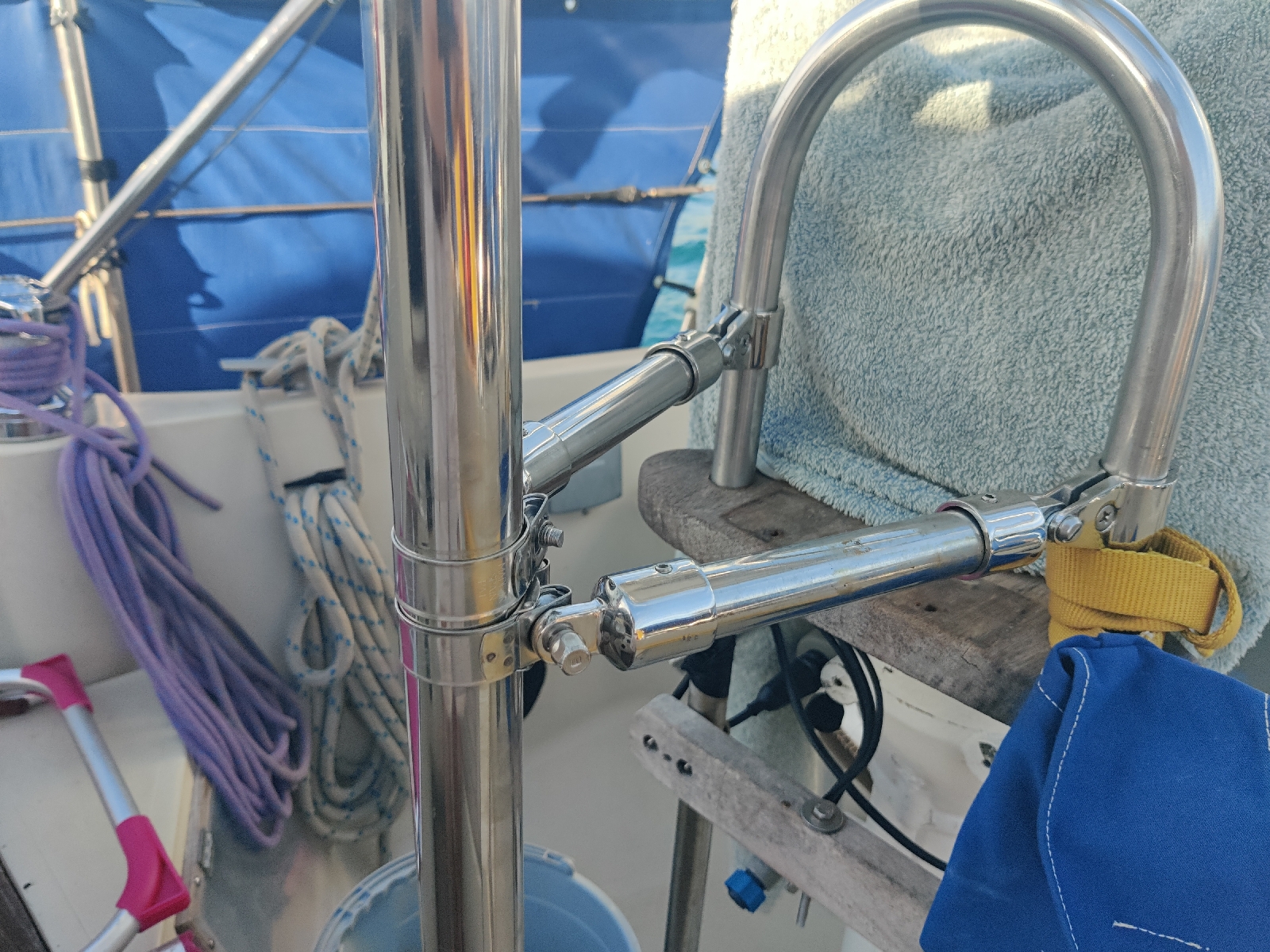
Next up was to figure out how to secure the pole in position. I already knew where I would install the braces, but how and what would they made of? Then I remembered I had retained some lengths of stainless steel tube on board after a previous job, just in case. I had enough to make up each brace but needed a way of attaching each end. The binnacle tubing and the superstructure tubing of the solar panel arch was the same size - 25mm I new I could obtain the necessary fittings in the UK - could I here? Attaching them to the pole of 38mm would be more of a challenge - they might need to be welded - that could be tricky and expensive. I decided on a trip to Las Palmas was required to get the tube - I tracked down a supplier and to see what I could find in the large Chanderly there to address the fixings issues.

Agustin to the rescue once again. He had to make a trip to the sailmaker there and so offered to take me; we stopped off to refill my empty gas cylinder on the way. There's only one place on the island that will do it!

After buying the pole and an appropriate deck fitting we headed for the Chanderlry. I quickly found they had the end fittings for connecting with the tubular braces to the other 25mm tubes but I couldn't immediatately find anything suitable for them to the pole. Unfortunately Agustin had left his phone behind and was expecting an important call later so we left with a potential solution begining to form in my head.

The next day I hunted through my various boxes of 'just in case' spares and found two flaat section flexible stainless steel U-clamps for securing pipework which looked like they would fit snugly around the pole. The end had holes that would take the 25mm eye fittings. I used jubilee clips to secure them to the pole and then set about cutting my tubing to the required length and by the end of the day had the pole securely fitted with the dish fitted on top and connected to the cable. Then I realised that I could still use the second hole in the deck for the cable - in fact by a pure fluke it was in just about the ideal place - I fastned the cable to the solar panel superstructure tubing and the hole in the deck was close by its base!

I was feeling pretty pleased with myself - no welding necessary. I did think something more robust than the jubilee clips and flexible clamps was needed and so the next day I headed back to the Chanderly on the bus. I found some stronger tube clamps (and met up with fellow OCC member John Passmore of 'Old Man Sailing' fame, who survived a knock down in his Rival 32 en route to Las Palmas.

The next day after reaming out the eyes in the end fittings I finally finished the installation of the new physical superstructure. 
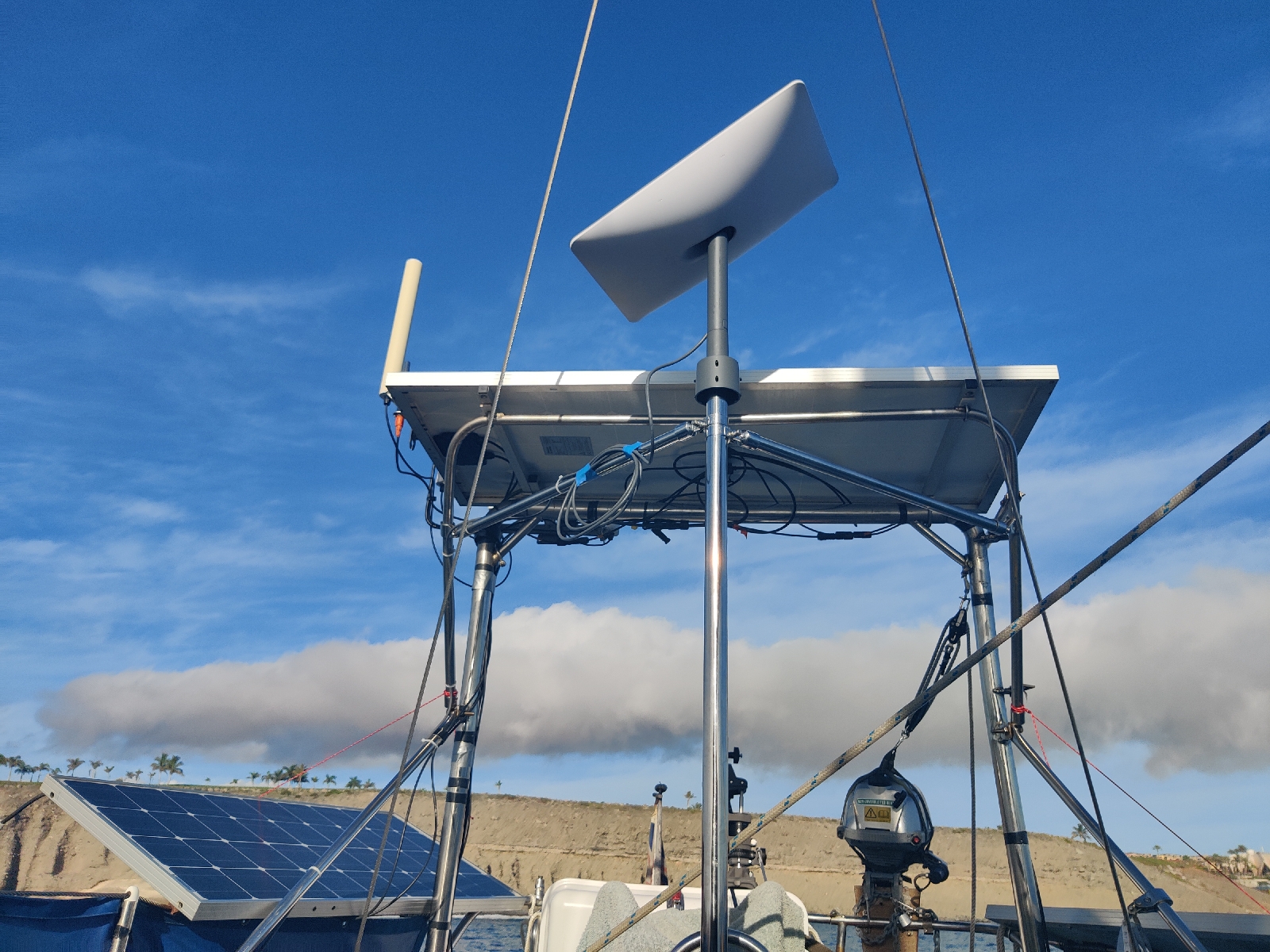

All I had to do now was plug in the router to the inverter and hey presto I would have my own satalite internet connection. The only problem was I didn't. The little light on the bottom of the router winked seductively at me but no internet connection was forthcoming - as far as I coud make out the whole system was dead!

After ploughing through Starlink's troubleshooting reources on line on the very flaky local wifi I finally discovered that that little light should not be winking - a solid light indicates all OK - winking is not mentioned but it seemed pretty clear it should not wink. I didn't understand it. There was clearly power there and the inverter produced more than enough power to drive the 4 Amp Starlink.

There was only one other thing I could try - the boat's second 2000 Watt inverter but which is not cabled in to the boat's wiring system. So I set about lashing up a connection. It took a few hours but - hey presto it all worked. I was also amazed at how little current the Starlink seemed to be consuming so I just left it on. I was able to watch the world cup Rugby and everything.

The following night I was getting into bed when an alarm sounded from the main cabin. It was coming from the inverter. I turned it off scratching my head and glanced at the bettery monitor - the batteries were at 85% a little lower than normal for that time of day but fine. But wait a minute the voltage was only 10.9 not the 13.4 or thereabouts that it should be. This was impossible how could this be? I disconnected all the major utilities and ran the engine for a couple of hours to get the voltage up to 12 and the next day consulted Mick.

He was not at all happy that I had messed about with the electrics and quickly figured out that when I connnected up the big inverter I accidently by-passed the battery monitor. Result - Amps disappearing at a rate of knots but completely undedected. It tuned out that the inverter was gobbling up 4 Amps as soon as it was switched on and that Starlink was indeed also consumig the 4 Amps quoted.

Feeling pretty bloody stupid I sorted out the wiring and recharged the batteries which thankfully seem none the worse for wear. Thank goodness for Lithium Batteries!

Since then I've prepped as much as possible for the installation of a new solar panel which I'll get on Thursday - once again thanks to a lift from Agustin. We'll pick up Mick from the Airport too.

Agustin and Sonja threw the most fabulous party for OCC members last Saturday - I don't know how he does it!

My pal Howard is also due to spend a few days with us from Sunday. The plan is to undertake a sail to La Gomara early next week to test out the Hydrovane befor departing for Cape Verde or Barbados.

Stay tuned!


Update 1 from Gran Canaria


Today is Tuesday October 31st and altough I've been meaning to update the blog for ages I can't quite believe it's been almost two months since my last update just prior to Mick flying home to the UK for six weeks (which turned into seven) and he's due back here on Thursday (7/11).


Just as I was writing the above I was hailed by Paul (another OCC member) from his dinghy to say that unfortunately he was having to postpone his and Lori's invite to drinks and nibbles on his boat this afternoon on account of something in their toilet system having "exploded" and needed fixing! Hopefully that will be the only bad news of the day!


So what's been going on?


Well, to start with, play time in Las Palmas continued for a week or so. A couple of days after Mick returnd home, Sharon, Stephen, Ines, Amara and Baby Remi arrived for their week's holiday. Sharon stayed with me on board Bonny in the Marina and Stephen and Ines and kiddies stayed with Ines' brother Russel who lived just a 15 minute walk from the Marina


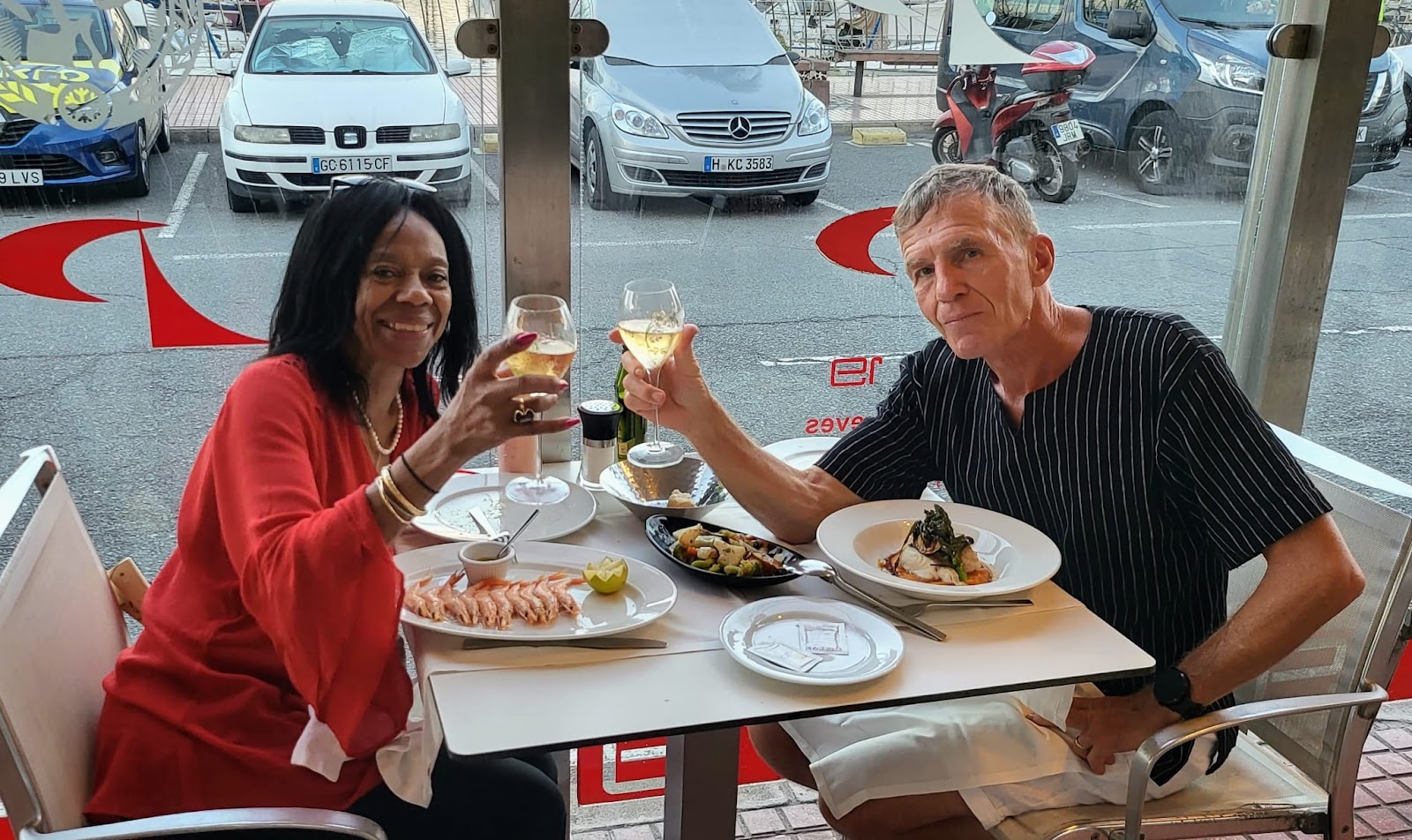
They actually arrived on the 12th of September which was our 36th Wedding Anniversary and Sharon and I celebrated with a very pleasant meal in one of the Marina Restaurant's that evening.


The rest of the week was spent sightseeing and holidaying in and around Las Palmas. This included a trip into the beautiful old town to the south of the port, with (for me) another tour of the Cathedral; 


a walk around the plush shopping area of the new town to the north of the port, a day on the beach on the north west side of the peninsula at the top of the island. It's a very long sandy beach and looks like it's straight out of a Brazilian travel brochure.


Whilst in the Marina in Las Palmas Augustin and Sonja visited to celebrate our anniversary and brought with them a gorgeous cake..


Sharon and I also visited Malcolm and Julie on board Ellen II a Moody 42. At 42 feet she was only 6 feet longer than Bonny but had twice the volume. Sharon fell in love with her straight away and wished I could have afforded one!


No pics unfortunately but here is one of another smart yacht that we were also entertained royally on, this one owned by American OCC member Joerg.


Malcolm's a member of the OCC and he and Julie have only very recently got together and will be crossing the Atlantic to the Carribean this year too. I had already been talking to Malcolm about his experience with Starlink, the new portable satalite system. Mick and I had completely failed in our attempts to download weather data via my old satalite phone and indeed had burned through 200 GBPs of satalite airtime trying to get the dam system to work. With climate systems becoming increasingly unpredictable and with the likelihood of complex weather systems to work through when we head up the North American seaboard next spring, I was rather keen on being able to get hold of good weather data.  Anyway, to cut a long story and convoluted considerations of the pros and cons of the mid range starlink system short, I decided to buy one. At 450 GBP and with monthly data at 85 GBP it looked like it compared favourably with the Iridiumgo system which cost around 800 GBP and provided a far slower internet connection. With Starlink we should be able to down load large scale weather forecasts mid ocean. 


Malcolm very kindly leant me his Stralink carry case which cost almost as much as the kit itself - comprising a satalite dish, a router, some cables, and a stand for the dish - so that I could carry it back on the plane after my forthcoming short visit back home. The die was cast.


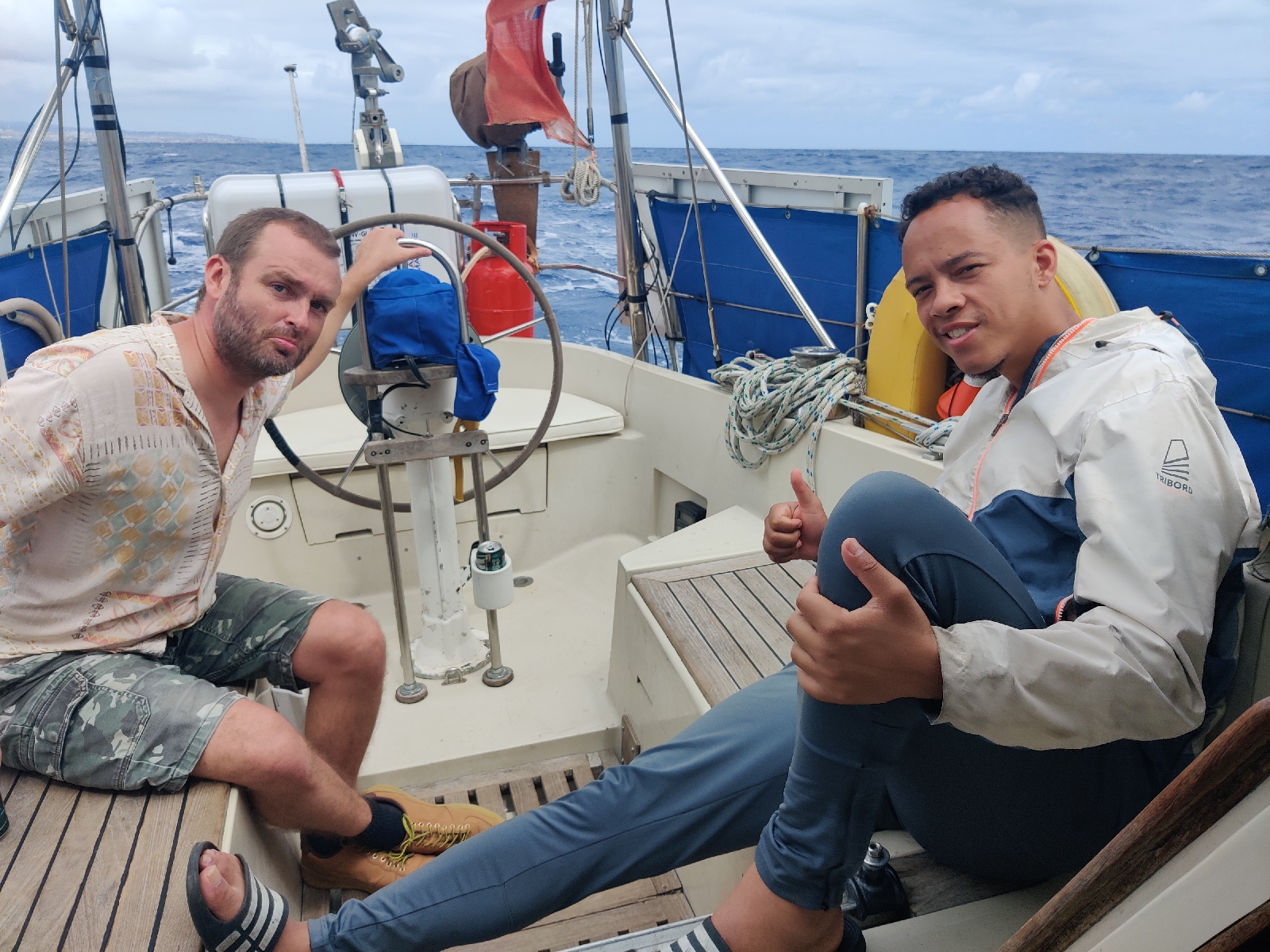
On the Sunday, Stephen, Russell and I sailed Bonny down here to Pasito Blanco, where I was going to leave her for a couple of weeks and return home to save some of my precious Shengen days and of course see the family. This would probably be my last chance to see everyone before next summer. The trip down took most of the day and we had a bit of everything with calms, very sloppy seas and some strong winds. The lads were both a bit queesy for a while but overall both enjoyed the trip. It was Russell's first experience of sailing.


Once again, Agustin was a tremendous help as he has been on so many occasions in the past and would be so again. Sharon and Ines picked up a hire car from the Airport after we left on the boat and drove down to Pasito Blanco to meet us there. It would have been rather a tight squeeze for us all on Bonny but Agustin very kindly lent us his boat to use for our short stay at Pasito Blanco. So, Stephen and co slept on board his boat whilst Sharon and I slept on Bonny.


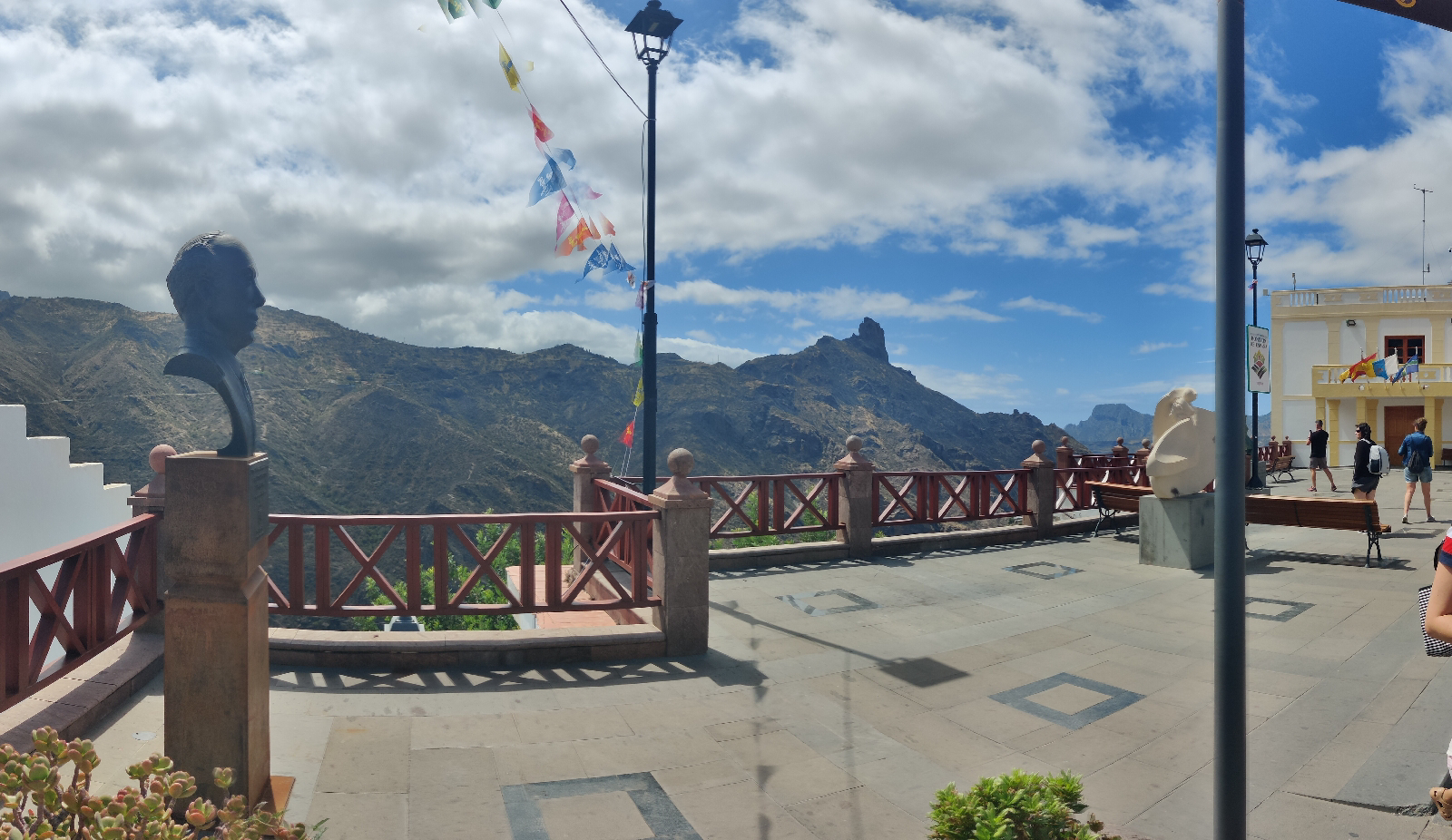
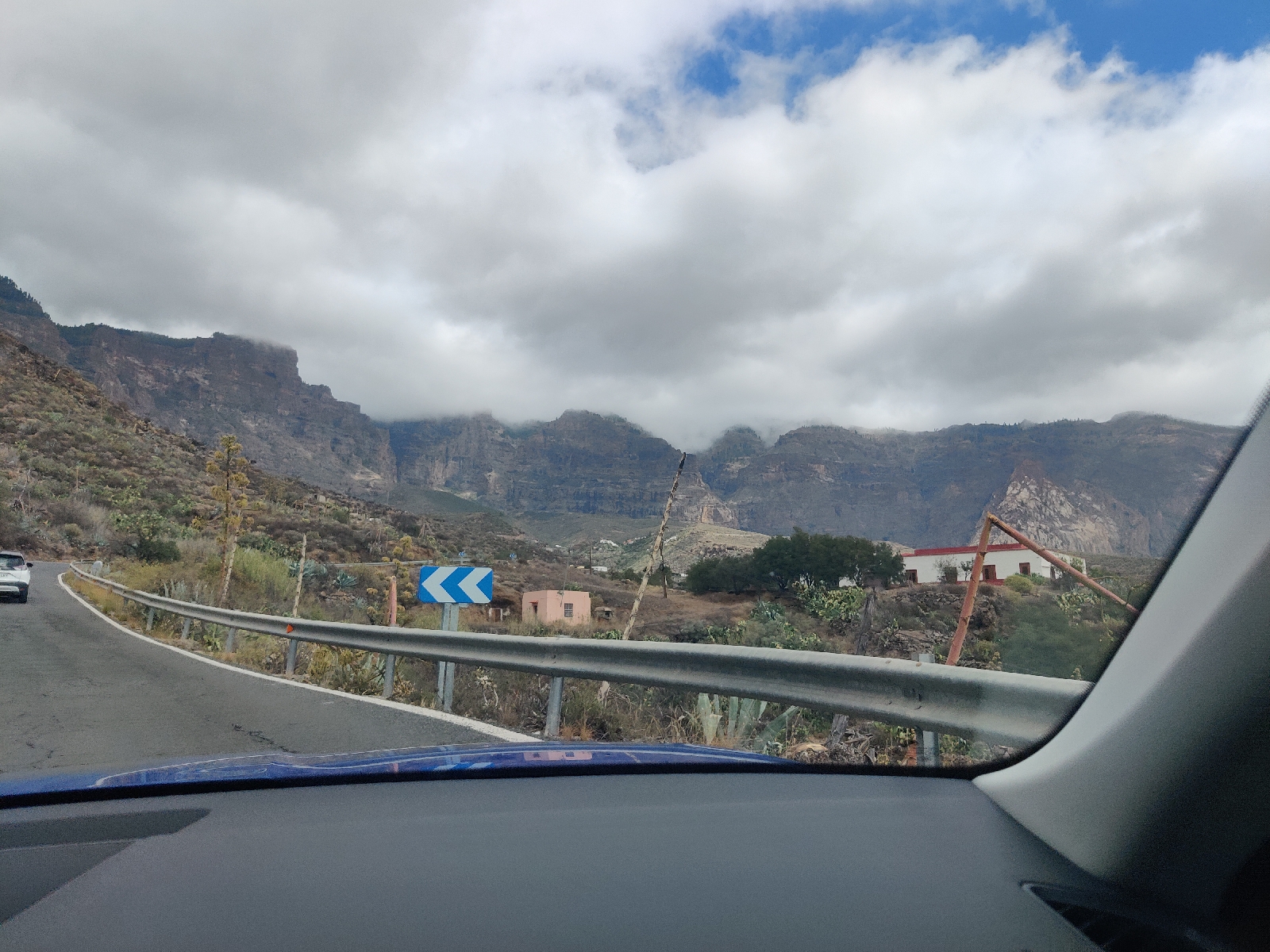
The next day we spent touring the island in the hire car. The scenery of the interior of the island is quite breath taking with imposing jagged cliffs interspersed with islands of forest and other greenary where, it's my guess, moisture is deposited by the clouds that form atop the peaks and from which even rain falls from time to time. The scenery brought to mind the lanscapes of the wild west so often portrayed in 'Western' films. The driving was quite challenging on some very twisty mountain roads but Sharon did an incredible job - she was the only insured to drive.  


At the end of the day we dropped Russell and Stephen and family off an Las Palmas and then Sharon drove us back to Pasito Blanco. We had had so much trouble with the mooring the previous night with the swell forcing the bow of the boat up agains the adjacent walkway that I had had to pull the boat so far back on the stern lines that it was almost impossible to get on and off the boat, so that night we slept on board Agustin's boat.


The next day we drove to the Airport, met up with Stephen and Ines and flew home. Sharon and Co went on the afternnon flight and I went on the evening flight.


The two weeks at home flew by. It was wonderful to see everyone again and I found it quite difficult to say goodbye once again after the short visit. During my stay there was a big party at the house to celebrate various birthdays including Charles; Sharon and I visited my Mum and Stepfather in Norfolk and I visited my Stepmother and we both visited my brother Basty and Gill in their lovely 'new' house in Peckham. Before I knew it it was time to head back to Pasito Blanco. The shortness of the visit being dictated by the cost of the marina fees. Agustin very kindly picked me up from the local bus station after my bus ride from the Airport and as soon as I was back on board and the wind eased sufficiently I moved the boat out to the anchorage which was free.

Tuesday, 5 September 2023

Work, rest and play in Las Palmas

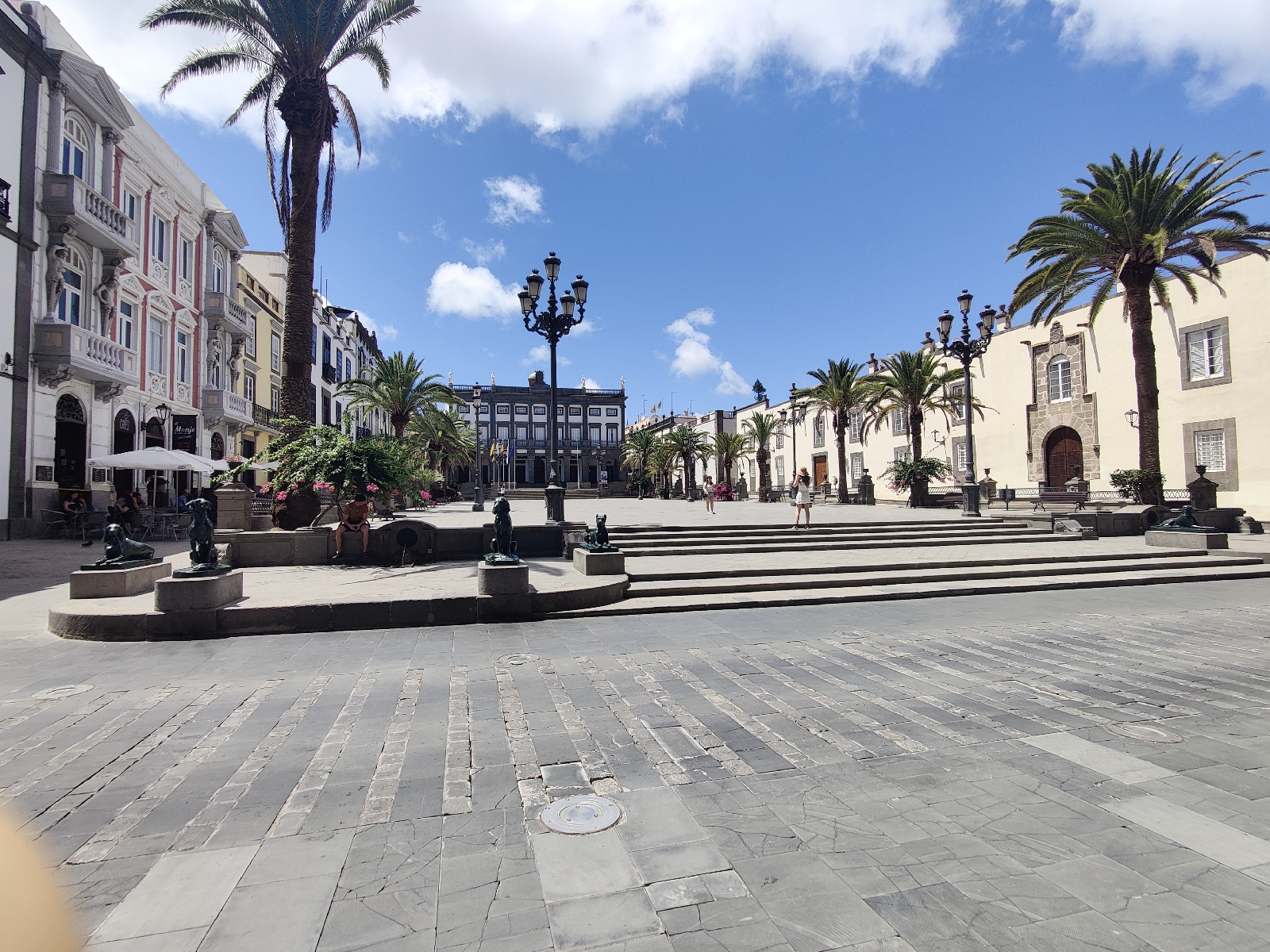
Above, the square/plaza opposite the very impressive Cathedral (see next) in the old town..
We've been here a week now but it's difficult to know where the time has gone. We have though got through some of the seemingly endless list of boat jobs.....

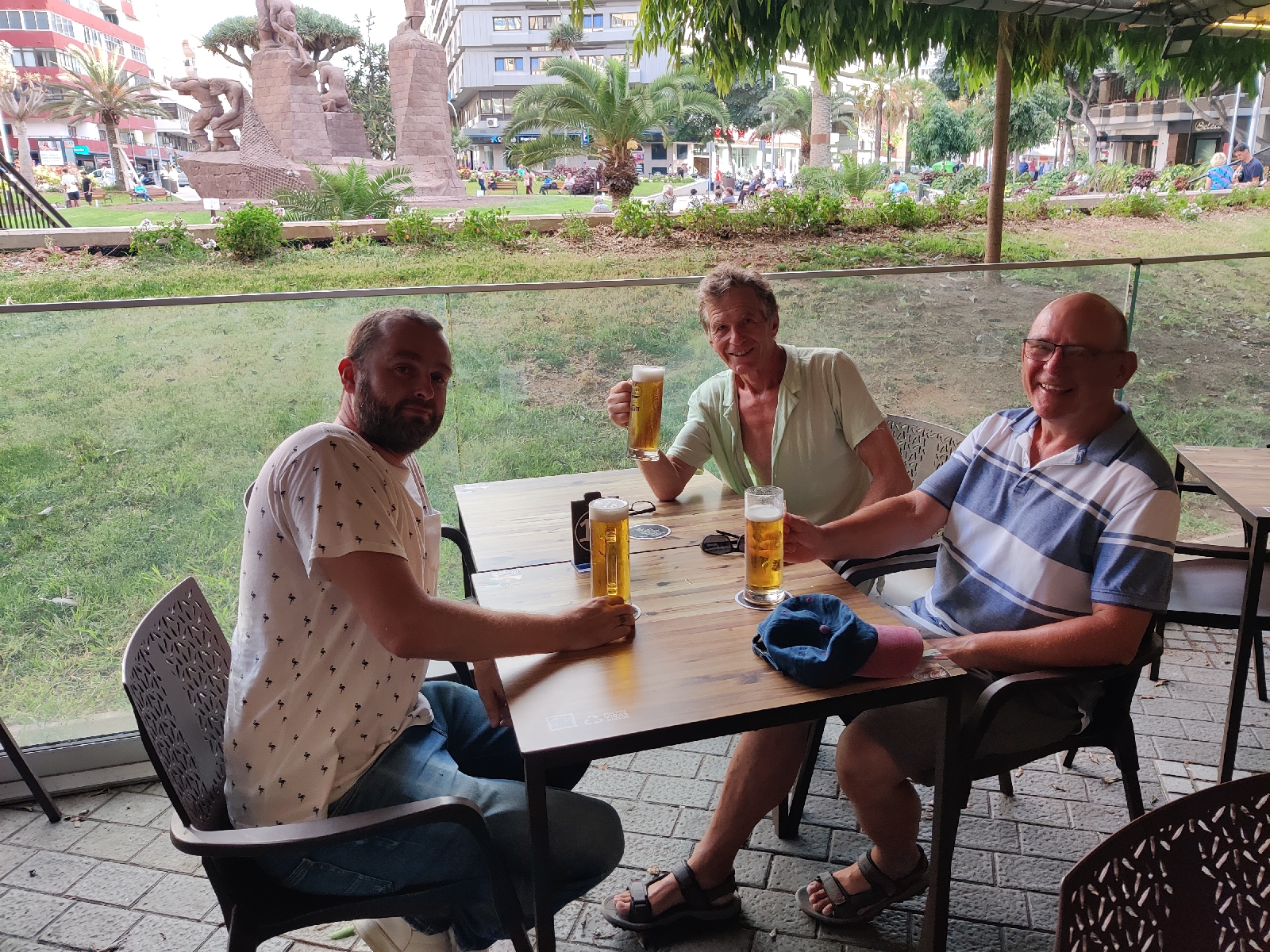
and we've enjoyed some social time including doing our bit to support Anglo-French relations.

It also appears that we should be able to keep our berth here in Las Palmas for the duration of Sharon's and Stephen's' family visit commencing 12th September - When we arrived the very friendly and helpful marina man warned me that we could only book ahead for seven days at a time and that we would be subject to seven days notice to leave because of the priority given to the ARC boats which start arriving in Las Palmas about now. When I went to book a further seven days yesterday the same guy was very laid back about it and said, come back in about a week or so (pointing to the 16th September on the Calendar) and pay me then and tell me how much longer you want to stay! 🤞

Our first full day here, last Tuesday was a pretty lazy one.  To coin a Monty Python phrase, it was a sort of "all of a sudden nothing happened" type of day. I did nothing at all apart from my laundry and making a start on updating this blog with an account of our time in Madeira.

Ah, I forgot the small matter of spending, or at least, commiting to spend, a large wod of cash and in the process wiping out my emergency sailing budget in one go. After a vidio call with Will from Hydrovane, I finally ordered the necessary replacement parts for the Hydrovane. They will be delivered to my Spanish friend Agustin who lives in Pasito Blanco on the southern tip of the island.

Wednesday was another day of rest and blog writing while Mick went off to explore the town. 

That evening we enjoyed the first of our Gran Canarian social events - we met up with Ines' globe trotting brother, Russell, who having spent many years in Columbia, Thailand and Japan has spent the last few years in the Canaries and has most recently moved to Las Palmas from Lanzorote. Russell took us to a lively bar/restaurant in the modern city centre where we spent a most enjoyble evening. Stephen and Ines will be staying with Russell when they visit with Sharon in a couple of weeks.

On Thursday  we got stuck into some serious boat maintenance however. I spent the day crawling around in cockpit lockers and under the cockpit floor maintaining the autohelm and main steering gear. 

This required becoming something of a contortionist given the tight and awkward spaces involved. It was also quite dirty work with generous helpings of crease and grime and as a result I looked non too savoury...

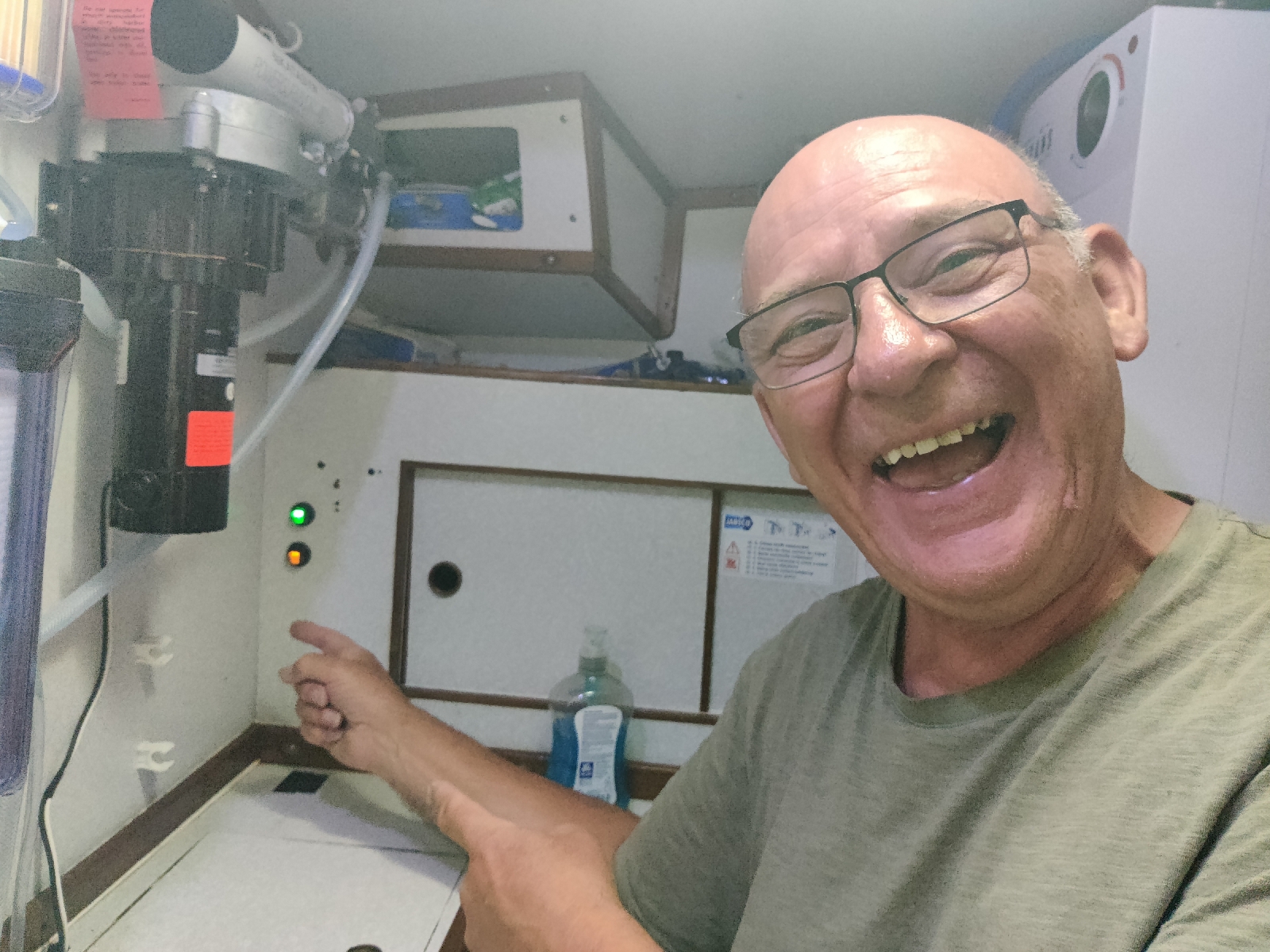
Whilst I was performing these antics Mick was installing switches in the water maker's electrical circuit. A fiddly and time consuming job. He's very pleased with the results because they light up when on! 

Indeed because the boat is to be effectively harbour bound for the next two months we have had to "pickle" the water maker's membrane. This involves sucking up a cocktail of chemicals into the membrane housing to kill off any biological growth that may be present and which would otherwise clog up the delicate membrane through which the sea water is forced when the water maker is in operation.

Friday was another day of boat jobs and one where once again I spent a great deal of time up the mast. 

I had four jobs to do up there. One was to replace the pulley block through which the cruising chute halyard ran (or rather was supposed to run). This you may remember disintigrated on our passage from Vigo to Porto Santo. A closely related job was to check the other hardware on top of the mast to ensure nothing else was suspect. The broken block was clearly no where near robust enough for the job it was doing and I really should have noticed that before and replaced it in 2021 when I replaced the shackle that attached it to the mast head. Or perhaps I did - because it's most likely that the original block would not have survived chrashing to the deck - but only had a flimsy block to hand and then forgot all about it! Thankfully all the other fittings up there looked sound and robust.

A further job was to re-reeve the mainsail haliard should run through a sheeve at the top of the mast and down the inside of the mast and out through another sheeve at the bottom but which for the last few weeks was, following the parting of the halyard from the sail (for the second time since buying the boat) on the passage from Plymouth to Falmouth, reeved on a temporary basis through an external block attached to the top of the mast. Having spent hours doing this previously with the help of my friend Bill on Bonny's mooring on the Medway, I was prepared for another long and tiresome escapade. What made this job such a fiddly one was that Bonny's mast was lined with slabs of polysterine - presumably to stop or at least minimise the noise halyards make when they flap around inside the mast. All well and good, but it makes running a length of rope from the top to the bottom an absolute nightmare - it keeps getting stuck! Bill and I only managed to do it before by removing quite a lot of the polysterine! Perhaps as a consquence, this time it would be easier! 

Step one: lower the genoa so that I can use the genoa halyard which also runs through a sheeve at the top of the mast to climb up (I had previously used a halyard that went through the block that broke!!!)

Step two: remove the sheeve at the bottom of the mast through which the halyard is supposed to exit

Step three: put absolutely everything (of course one always forgets something at this point) I need in a bucket and haul it up the mast on a spare halyard

Step four: climb up the mast using the mast climbing kit (rather like a cross between rock climbing gear and a bosun's chair) with a safety line attached to another halyard by a clever device that enables you to slide it up the halyard but which jams tight if weight is applied to it.

Step five: tie one end of long length of this twine on to one end of a piece of bicycle chain (this is ideal for pushing over the top of the sheeve and provides the weight to pull the twine down the mast).

Step six: lower the chain and twine down the inside of the mast until you think it's near the bottom sheeve. 

Step seven: call Mick up from below and ask him whether he can find the bicycle chain 

Step eight: jiggle the chain up and down (he hears it but can't see it) - repeat numerous times

Step nine: pull the chain and twine back up the mast and do what should have been done first - lower it down the outside and mark the twine so that you know when it will reach the sheeve:

Step ten: repeat step eight repeatedly!

Step eleven: Mick looks for various devices to help locate and retrieve the chain - takes ages!

Step twelve: Mick locates bicycle chain and pulls end out of the mast but it gets jammed!

Step thirteen: have a shouted debate about what to do next - decide to remove the bottom sheeve through which the genoa halyard runs to see if we can un jam it there. This is the sheeve through which the halyard on which I am suspended, runs and so....

Step fourteen: come back down the mast!

Step fifteen: - lunch!

Step sixteen: start to remove sheeve before realising that the track for the storm trysail (a small sail to use in place of the mainsail in gales) runs over it and so it cannot be removed without also removing about 50 rivets holding the track to the mast!

Step seventeen: abandon that idea.

Step twenty:  remove the sheeve for the topping lift (that's the piece of rope that runs from the end of the boom to the top of the mast and down to its base so that the boom can be held up when the mainsail is not set).

Step twenty one: find the chain jammed at the top of the sheeve and spend ages fiddling and jiggling around with scredrives and things until the chain miracously unjams and falls down to the mainsail sheeve.

Step twenty two: pull chain out of mainsail sheeve until it jams again!

Step twenty three: more fiddling and jiggling until eventually the chain comes out with the twine still attached.

Step twenty four: go back up the mast, tie a stronger length of chord to the top end of the twine.

Step twenty five: Mick gingerly pulls on the twine until the chord comes out the of the sheeve.

Step twenty six: attach the halyard to the chord and tape up carefully to achieve a smooth join.

Step twenty seven: Mick pulls on chord until the halyard exits the mast!!!!!

Step twenty eight: reeve the new emergency halyard through the external block (this so that if heaven forbid, we lose the halyard up the mast again - we can get the sail back up easilly).

Step twenty nine: climb back down the mast  

Step thirty: replace the two sheeves at the bottom of the mast and put everything else back in its proper place

Step thirty one: drink a cold beer!

Whilst all this was going on and in between his repeated trips out to the base of the mast, Mick was working down below on trying to coax our portable fridge which can freeze stuff and can therefore - if it works - store frozen meat and most importantly ice during our long passages and when at anchor in picturese Carribean bays! Initially however, his efforts were in vain, the machine refused to power up at all - which was a backward step. Subsequently, however a second spell of work proved successful and we now having a working freezer!

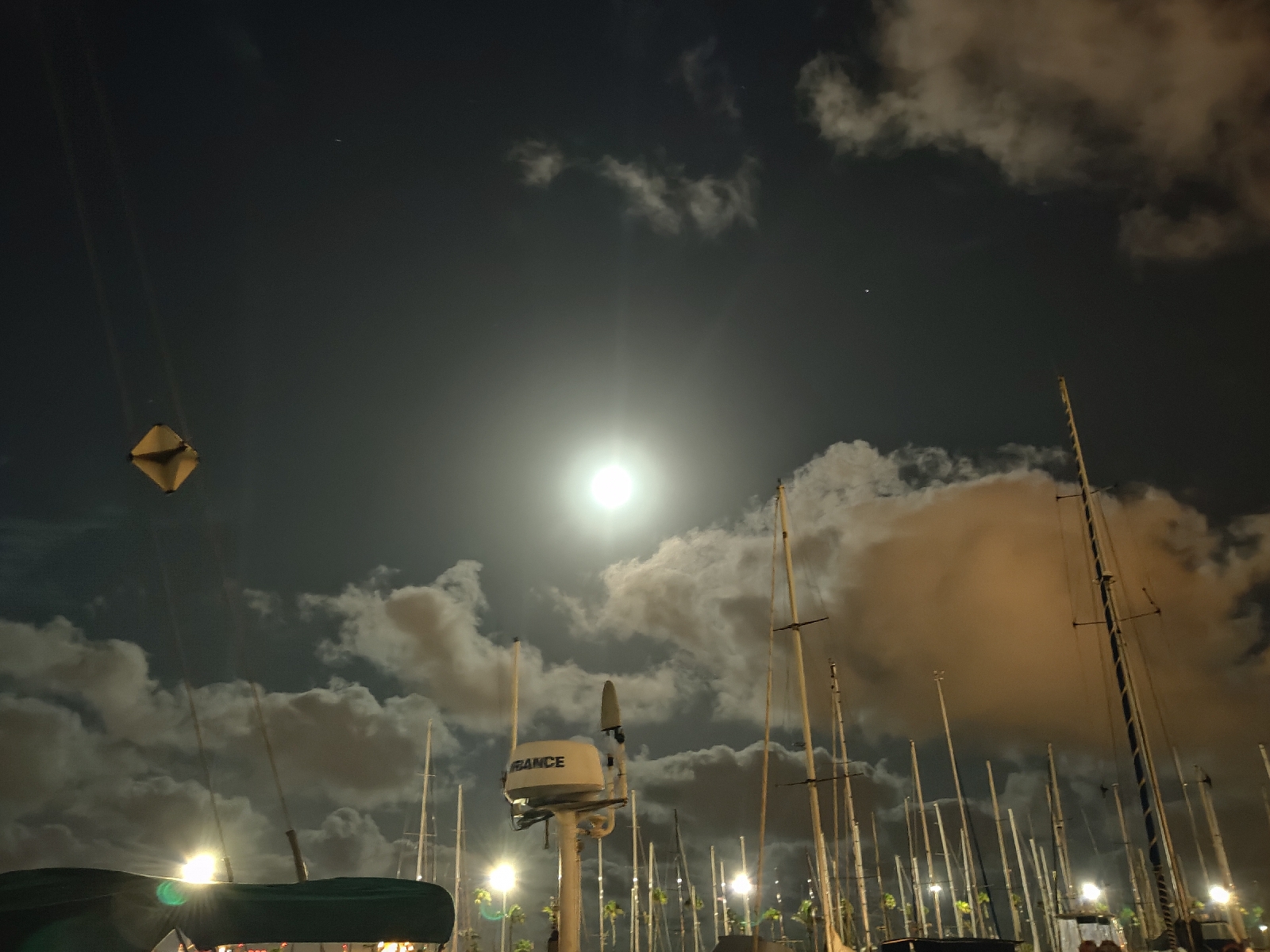
Friday 1st of September included the night of the full blue moon and very bright it was too. My granddaughter Maliyah was doing a school holiday project on the moon and so I sent her mum lots of photos of it over the harbour which was just as well because of course it was cloudy at home and they didn't see it.
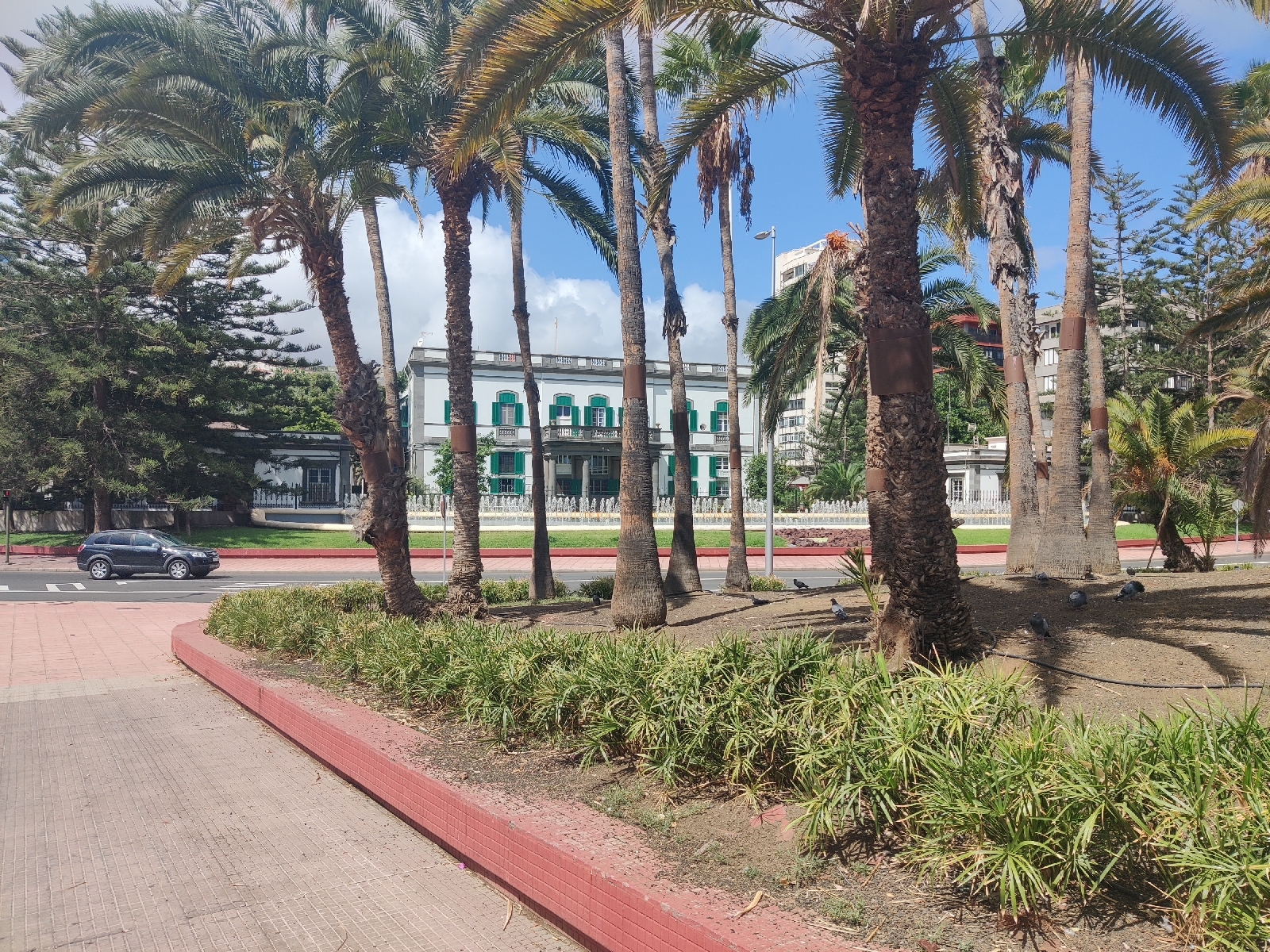
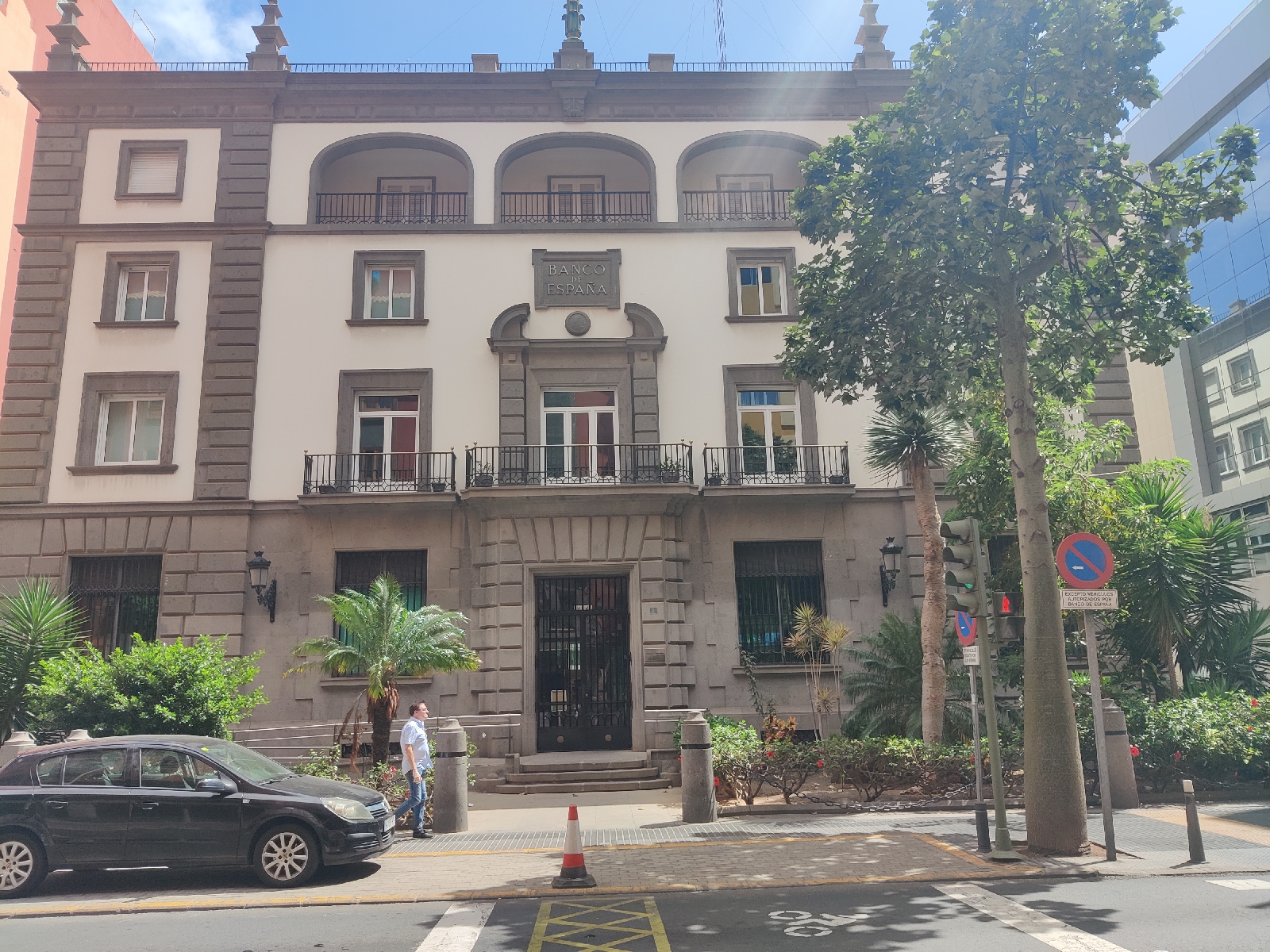
On Saturday the crew were granted shore leave and went off to explore the old town and very attractive it is too with its magnificant cathedral and colonial era plazas and buildings. Like Gijon, there were numerous narrow streets with restaurants and bars a plenty.

Saturday was also the day we met Franck, and enigmatic Frenchman and ex Ship's Captain, who seems to have spent the last 10 years or so sailing around the world in various sailing boats. 
Some years ago on his previous boat - a modern racing machine with a swinging keel he was almost sunk in a storm of the South African coast. The keel strated to part company with the rest of the boat and his sails blew out. Somehow he managed to make port and affect temporary repairs and then sailed on to Horta in the Azores where he found his current very tough looking 50 foot aluminium boat - "Sunditude" for sale. He then sailed his previous boat on to Jamaica where he had found a buyer. He's in Las Palmas waiting for a new set of sails to be made and undertaking various other repairs having experienced yet more bad weather in the recent past. He's a very entertaining and fun loving character. Not quite 60, the internet age seems to have missed him, he doesn't even seem to have a mobile phone! He does though have an email address so we'll be able to keep in touch. He will probably head down to the Cape Verde Islands in a couple of months too.

Sunday was another day that seemed to disappear without very much happening. I walked round to the Marina office and booked our berth for another 7 days and did a couple of minor jobs.

Yesterday, Monday, was a more productive day, I managed to service all the cockpit winches and Mick got the freezer working again.


This afternoon - Tuesday 5th September we're meeting Malcolm, a fellow OCC member, for a beer, who may be able to help us resolve the ongoing issues with our Satphone!

Mick flies home for 6 weeks or so tomorrow and Sharon, Stephen & Ines and kiddies fly out to join me for a week on the 12th. I'll plough on through the still growing jobs list whilst I'm waiting for them to arrive.