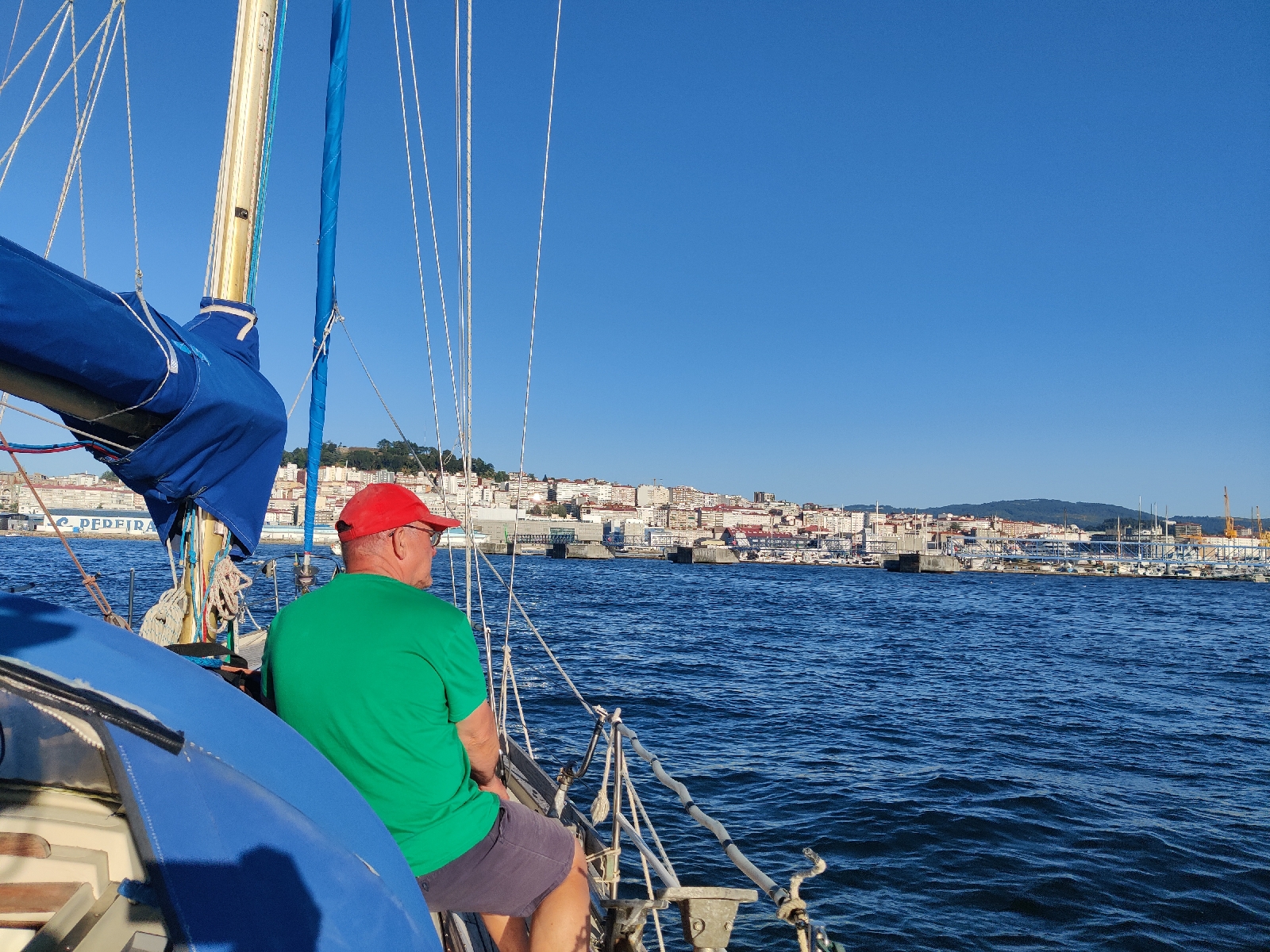
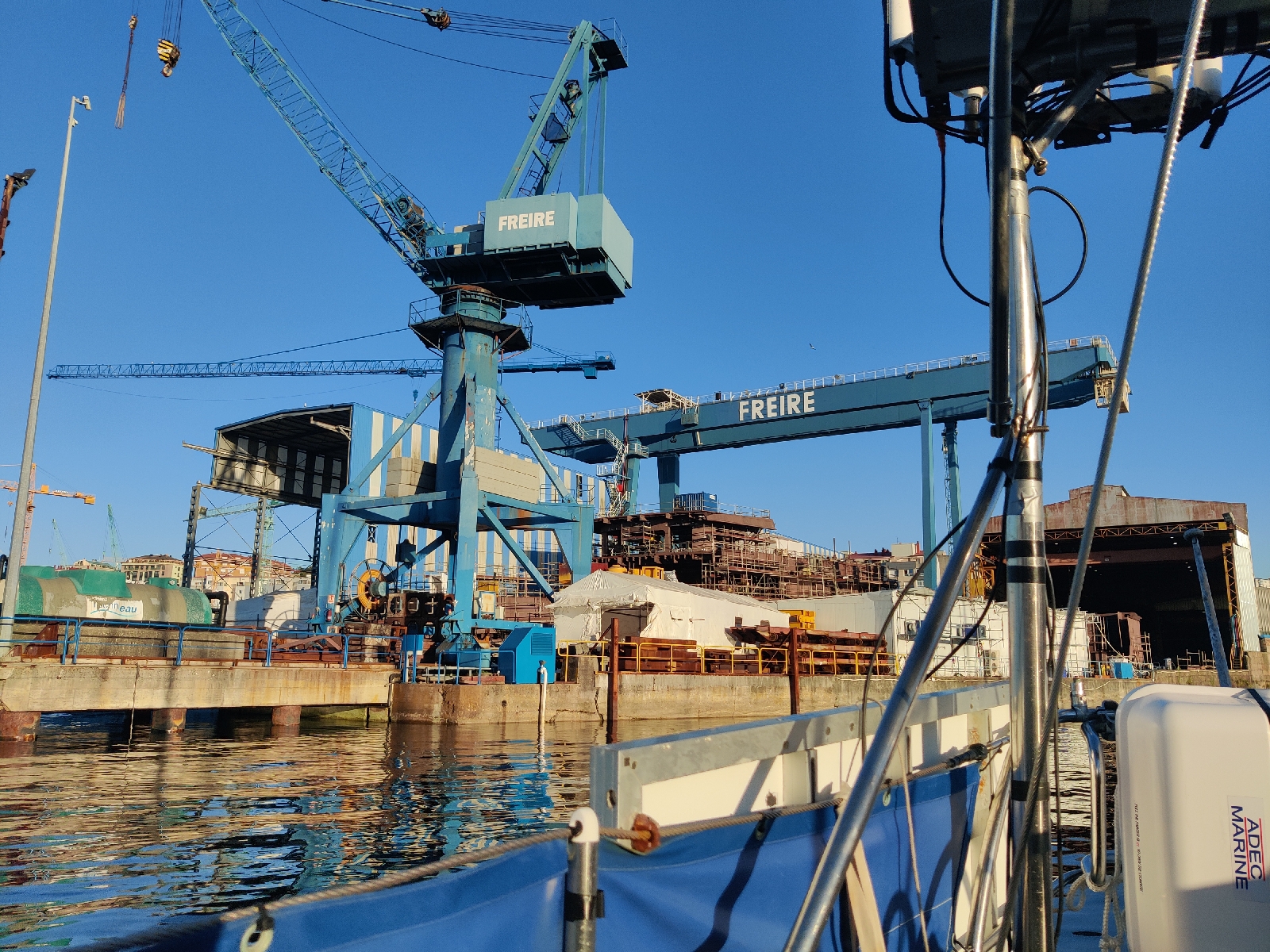
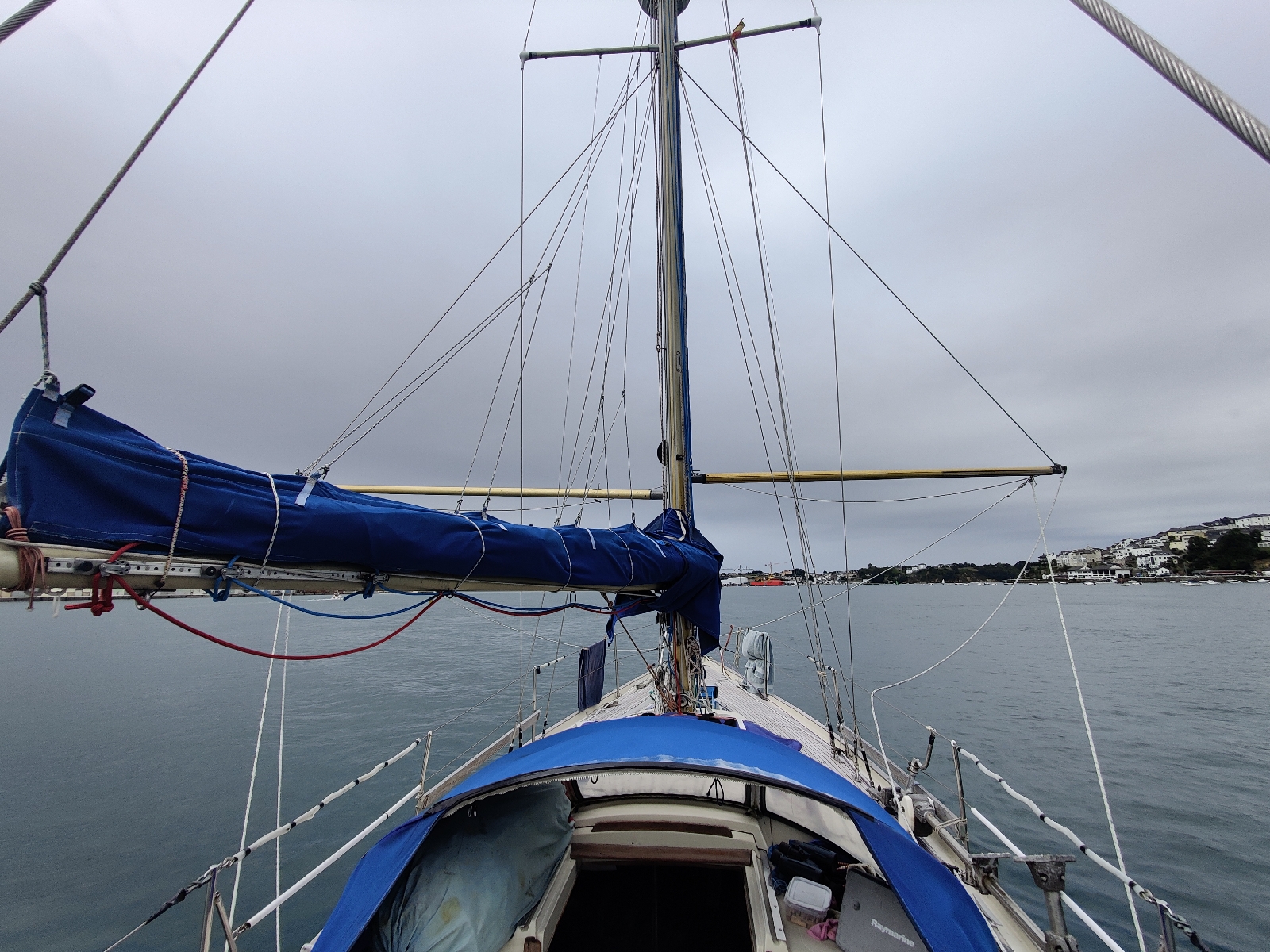
After departing the fuel dock at around 1415 local time we headed out into the Ria, waved goodbye to Bouzas and Vigo and set sail for Porto Santo

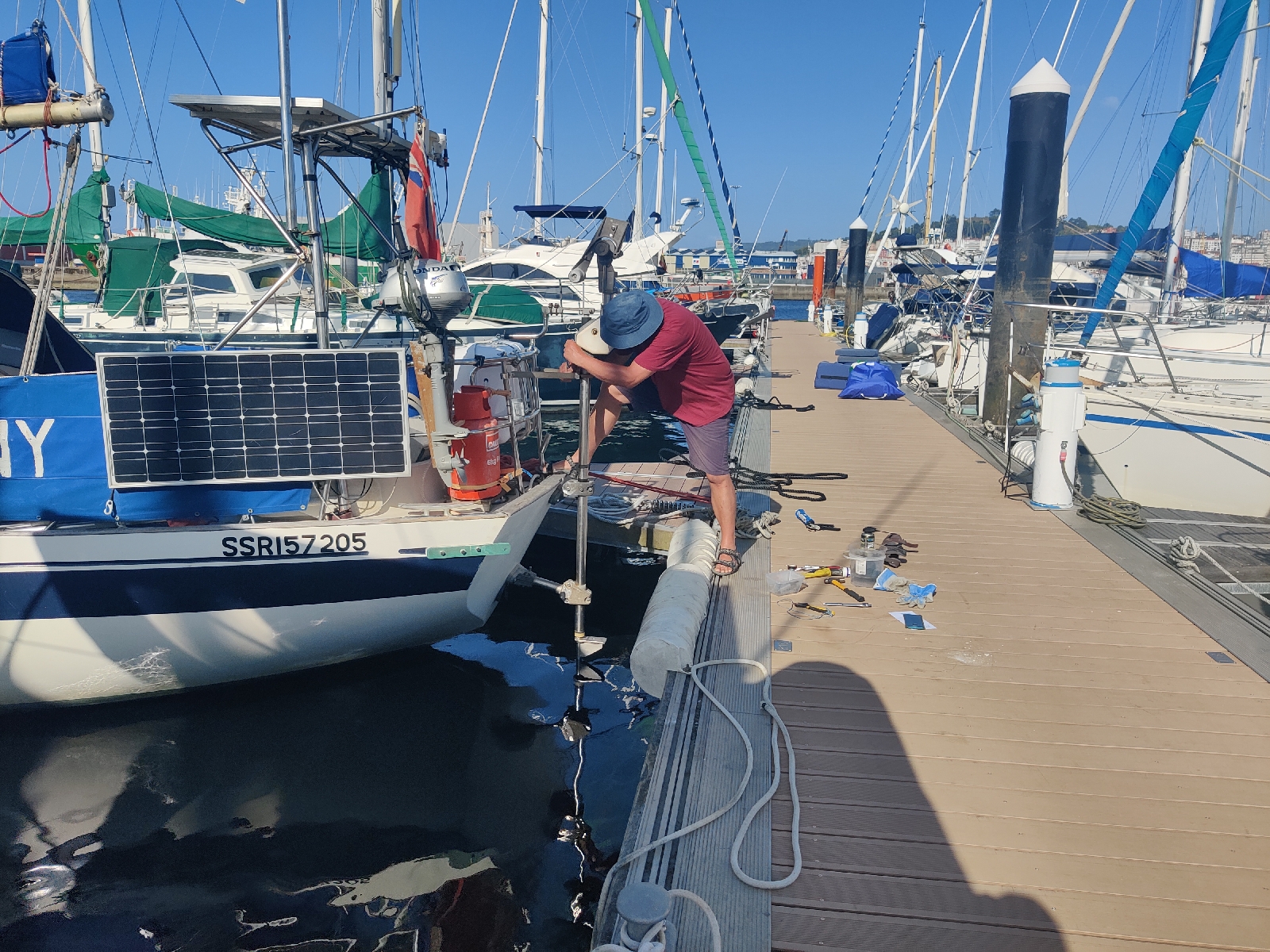
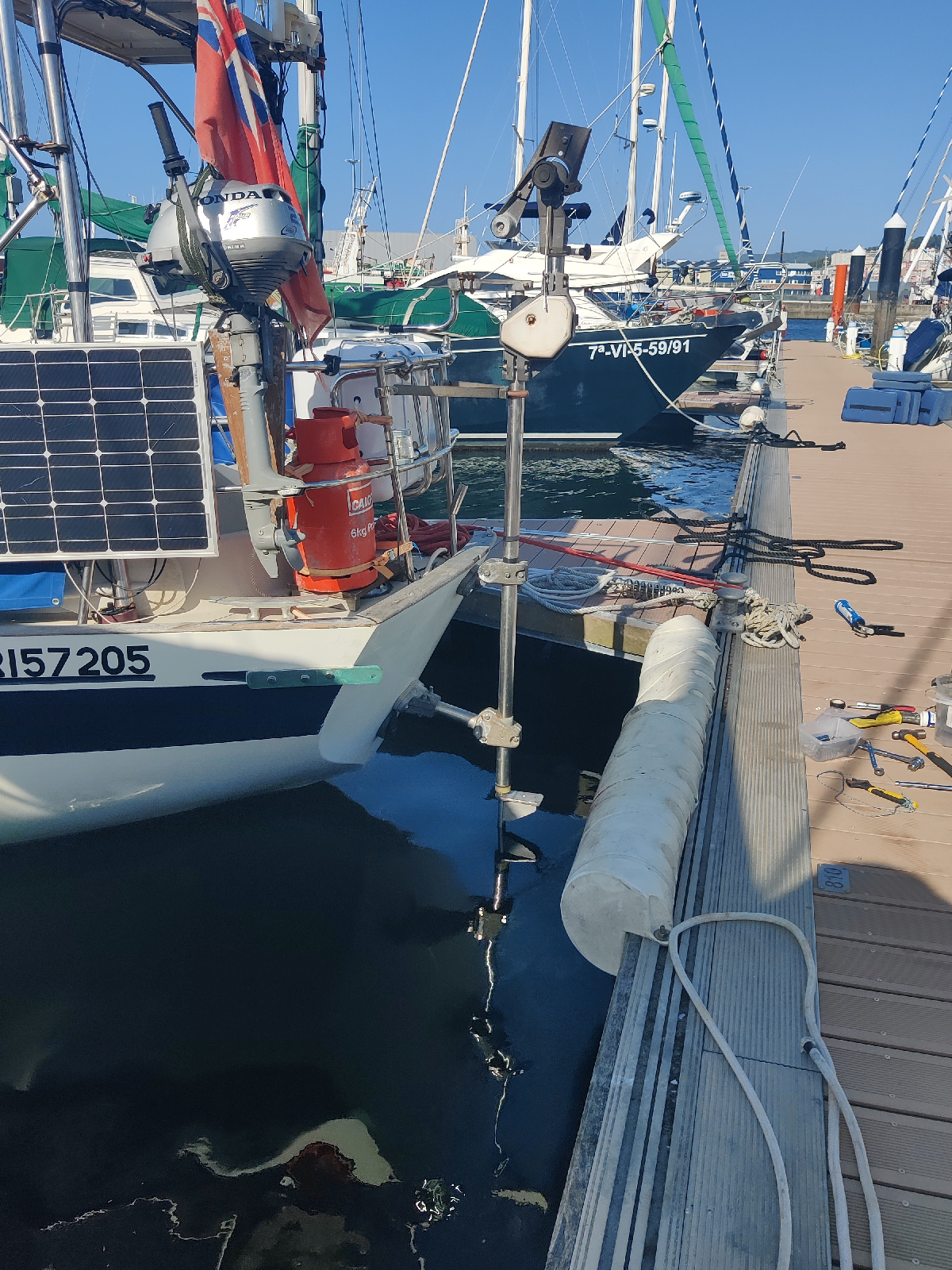
Once we had tidied up lines and fenders, we brought the repaired Hydrovane (which I have now named Lolo after the wonderful man who affected the repairs) into service and happily Lolo worked perfectly. I have to add a note here to record the Mate's disaproval of the name. Not that he disapproved of Lolo the man, but he thought the name should be one, more recognizeable to the folk back home!
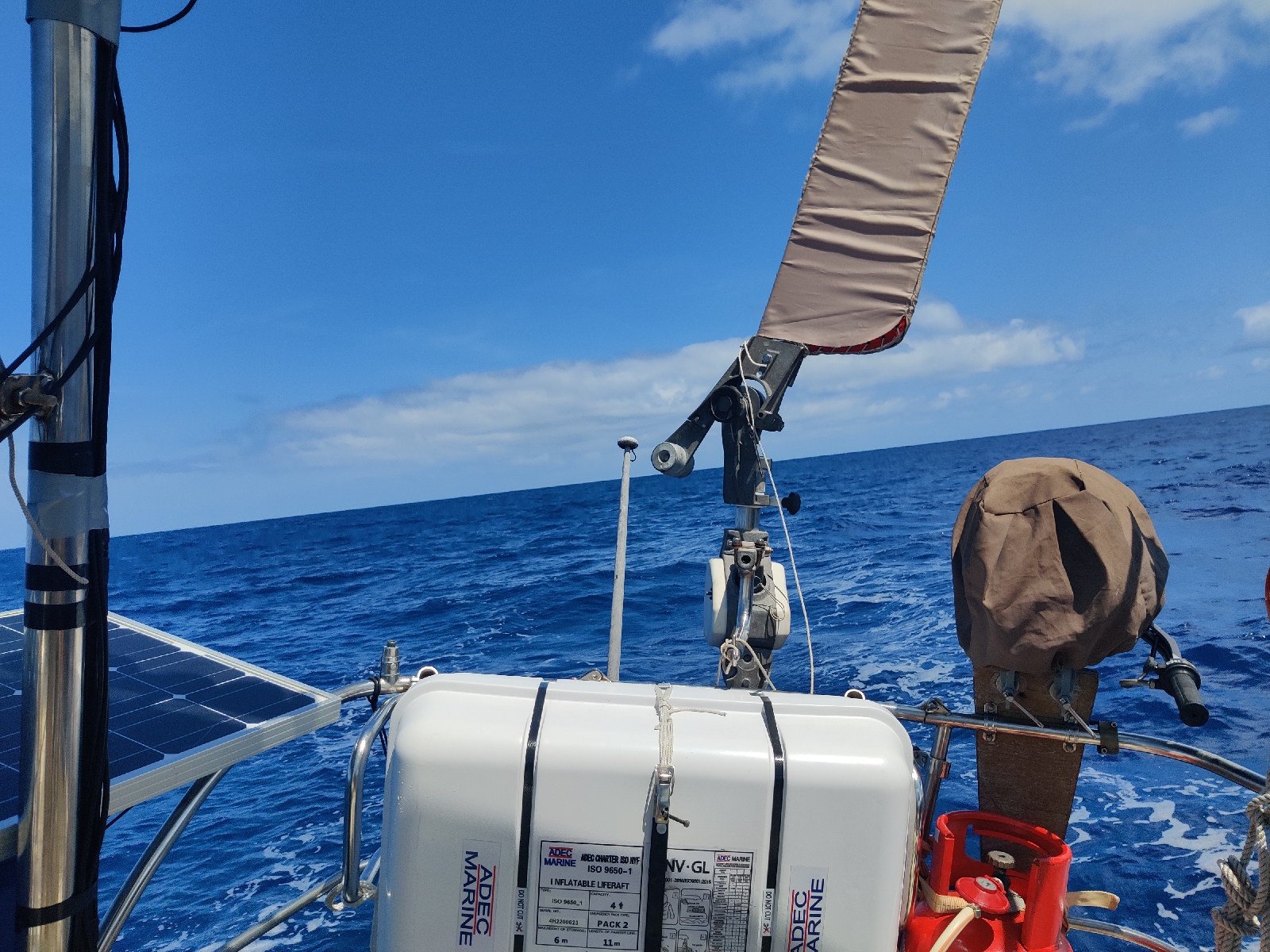
The wind was quite fresh from the north west in the Ria and we thought we may need to reef before long but once out in the open sea it moderated and we proceeded under all plain sail in a south westerly direction to gain an offing from the coast and so hopefully avoid the attention of any overly inquisitive Orcas that might be lurking beneath the waves. I had checked the various Apps and web sites that had been established to monitor the whereabouts and activities of the Orca but none had recorded any sightings in our area.
Based on the latest weather forecast on leaving, our broad passage plan was to head south west on a broad reach for a few hours and then turn south probably on a dead run for the next few days before, around the latitude of Lisbon, turning south west once again and then later west for the last day or so into Porto Santo. As Mick said, a route a bit like a hockey stick. The reason for this was to stay in the areas of good winds and skirt around a calm patch that was predicted to form further offshore to the West. The Mate spent some considerable time communing with the GRIB gods before pronouncing himself satisfied with where exactly our weigh points should be placed to ensure our hockey stick was of just the right shape and dimensions. Whilst doing so he was overheard to mutter something to the effect that a competent skipper would have ensured he had the necessary weather routing software so as to avoid the need for him (the Mate) to over tax his little grey cells! Little did he know that skipper did indeed have the said software but had not yet got round to figuring out how to use it. So for the time being the Skipper bit his lip!
Later that evening we made our course change to the south on a near dead run and boomed out the genoa to windward. We left the mainsail set to port with a preventer to minimise the risk of an accidental gybe rather than replace it with the gib on the other pole. This was partly due to laziness and partly because we anticipated the need to revert to a more south westerly course later. The winds being moderate also lessened the risk of any serious consequences in the event of an accidental gybe. As it turned out, Lolo proved quite capable of holding Bonny on a run without gybing.
Over night the wind freshened somewhat but the Mate dealt with that without waking the skipper, by taking in a few rolls on the genoa. A messier and smellier incident also occured on Mick's Watch, the deisel heater started leaking deisel.

Not being familier with the stove all Mick was able to do was try and soak up the spillage with kitched roll. On getting up I turnd off the fuel supply and eventually when all the deisel in the pipe between the tank and the stove had ran out, the leakage stopped. Luckilly most of the deisel was caught in the steel tray in which the stove sits, but we still have some residue spillage that has soaked into woodwork, to try and clean up.
Sailing boats are strange things - they make lots of noise if they are going 'too' fast (especially too windward) and lots of noise if they are going 'too' slowly. When going fast, the noises are many and varied, such as the water rushing down the side of the boat; the occasional "boom" as a wave hits the side of the hull at just the 'right' angle to spray the boat in a heavy shower of sea water; and more extremely, when a wave of 'solid' water sweeps over the boat with an explosion and roar. The positive thing about all these noises is that they are produced by speed and that's what a sailor wants. Because, whilst we all love the sea, their aren't many of us, who, having spent perhaps weeks in some port or another waiting for the right weather to move on and head back out to sea, aren't very keen indeed to get to the next port as quickly as possible and start the whole cycle over again! The longer the passage the less intense this desire is, but nevertheless, a sailor can often sleep soudly amogst the cocophony of sound produced by a fast moving boat because he or she knows they speeding (if indirectly) towards their destination.
Slow moving noises on the other hand, are absolutely guranteed to ruin what would otherwise be a good night's sleep. Worst of all is the slowness after a strong blow, when the wind has all but gone, depriving the vessel of power but the waves are still lumpy, often as not coming from more that one direction at once. The affect is to toss the boat about like a cork, but unlike a cork there is no shortage of stuff that when shaken, will chrash bang rattle and roll. It happens in the rigging and down below - everything that is not securely fastned down will move and make noise. On an old boat like Bonny there are plenty of sources including her joinery itself. One surface moving minutely against another can produce the most irratating squeaky cracky noises. Last year I spent hours in search of a rattle before I realised what was going on. Quite apart from the noises themselves, the effect on one's psyche of knowing the boat is barely moving in the desired direction and indeed is sometimes going in completely the oppopsite direction, either backwards or forewards, is one of great irratation, not at all conducive to a good night's sleep.
And of course lack of wind and slow noises seem more prevelent than too much wind and fast noises. Despite our bumby crossing of Biscay, this had already proved to be the case on our voyage to date. So, it was a major relief when I remembered at the outset of our passage from Vigo, that brother Andy had left me a pair of (unused) earplugs. At the time I did not appreciate how valuable these would be for my wellbeing, but I'll never put to sea without them again. Thanks Andy. However, they are probably not a good idea when sailing single handed. One needs to be much more alert when asleep when on one's own. It sounds strange, but once fully into the routine it is possible to sleep with 'one ear open'!
During my Watch the wind moderated again and so eventually I unrolled the genoa back to its full size. Sunday was a pleasant sunny day during which we made good progress of about 130 miles with no incidents or events of note and indeed Monday, with one exception proved the same.
The exception was our complete failure to get our Satphone weather system to work. The software on Mick's Android phone confirmed the GRIB request had been sent but we never got anything back. The satphone itself also announced a data call was in progress and so we were pretty sure that the outbound message/request was indeed sent and received. Hours of fiddling about failed to get anything back. The bizzare thing was that the same software was able to send a request and receive a response to a much less helpful, location based weather forecast.
Eventually, we gave up, but before doing so, Mick sent an email over the satphone to Roger, one of our pals back home, asking him to reply. We checked for a reply the following day but there was't one. Later I sent Roger a message via the yellowbrick, asking if he had received Mick' message. He had but when he tried to reply he got a bounce back error messaage. This seemed to confirm that with the exception of the one-off weather report (which is even more puzzling), replies were not getting through to the satphone. It looks like this may
be linked to the peculiar 'habit' the phone/Iridium system has of allocating completely random phone numbers to outgoing calls made on the phone. The recipient - whether it be a person or in the case of our GRIB service, a computer - is therefore unable to return the call.
Given Mick had spent £200 on buying 100 minutes of data time we were pretty hacked off. Time to get heavy with the supplier when we next get internet access! Over the next couple of days Mick composed an appropriate email complaining politely about the very poor service received to date and requesting that the supplier sort the problem out and reinstate his 30 days airtime which is about to expire but which we have been unable to gain any benefit from! We will await their response with interest! [Postscript: we are now anchored in Porto Santo and Mick is wading through yet further possible causes of the problem.]
All this of course meant that we were back to the 'old days' of trying to predict - i.e. guess - what the weather is going to do next. Actually it's not quite that bad because we do still have the GRIBs that we downloaded before departure.

These can contain data that looks up to 8 days in advance depending on which service one uses, but you don't have to be a sailor to know that the further ahead a forecast looks, the more unreliable the prediction. Predictions of two to three days ahead are usually the most one can rely on and when the weather systems are unstable, even less. GRIBs are 100% computer generated meaning they have not benefitted from human input like a traditional weather or shipping forecast will have done. Marine weather gurus have therefore long cautioned that they should not be overly relied upon. I suspect however that they are becomming more and more reliable with increases in computing power and that the arrival of AI on the scene may soon make them even more accurate than forcasts modified by humans.
However, back to our GRIB and our weather situation. We downloaded them (a few using different services and weather models) on Saturday afternoon as we left which meant that by Tuesday when we were trying to work out our weather routing tactics, we were working with a GRIB that was approaching its 'use by date'! However, the weather system was a pretty stable one and broadly, our real world experience of the weather was lining up with the GRIB.
After hours of fighting with software I also finally managed to get the weather routing software I had on the boat''s Rasberry Pi navigation system to work and I proudly announed this fact to Mick. The route it recommended was broadly in line with Mick's own previous weather route, causing him not too unreasonably I suppose, to blow his own trumpet somewhat. The main thing though was that we now had two independent routing recommendations that suggested more or less the same route. This was the previously mentioned hockey stick route around the area of light winds to our south west.
The joker in the pack though was that both recommendations were working with out of date data. We both suspected that if the now post-retirement GRIB was in error it was likely to have underestimated the extent to which the area of calms extended north and east towards the Iberian peninnusla. Subsequent weather experience bore this out, but we were too slow to react to declining wind strength as we followed a course broadly in line with the Mate's and the weather routing software's suggestions.
During the night of the Tuesday 14th August with Bonny sailing on a broad reach on the starboard tack, the winds steadilly eased in strength such that at the end of the Mate's watch at 0200 on the 15th, he remarked that we really needed to head further south east but thought that would put us unto gybe teritiory. Feeling lazy, I thought we could get away with booming out the Genoa and run dead down wind. This would put us on a course just east of south. We made the change pretty quickly and Mick was able to get off for his sleep.
After another three hours the wind had dropped to almost nothing and we were barely making way through the water. So I rolled up the genoa, switched the engine on and headed initially east and then after a conflab with Mick who pointed out that based on available data we should find the same strength winds to our south east as to our east and that we would also get closer to our destination if we headed that way, we did.
By 1030 on Tuesday 14th August we had found the wind and after much discussion based on the availble information we decided to stay on a southeasterly course for the time being. Around 1800, I raised the question of making our turn to head further south. After further consideration we agreed that owing to our excellent progress we could in fact now head for Meidera, but would have to be alert for declining winds anf if that did happen we would need to turn left once again. The challenge of course is remining alert!
Tuesday was a red letter day on the good ship Bonny. We tried out the water maker for the first time, a birthady present bought at great expense by Vincent and the rest of the family, which I fitted over the winter and spring.

As expected pre-operation testing produced a few leaks and in the process of trying to stem one of them we broke the input fittig on one of the sea water filter cylinders. Imagine one of those WWII Navy films featuring a submarine being depth charged and the crew dashing around trying to stop leaks by turning valves and tightening up fittings - well it was rather like that in miniture in Bonny's loo where the water maker occupies a prominent position on the aft bulkhead. Fortunately we had installed two seawater filters and so were able on a tempory basis to bypass the damaged unit and just use one. Having stemmed all the sea water leaks we turned on the watermaker which, combined with the sound of the seawater pump made quite a din comprising a number of different grunts and squeakes that together produced a rather comical sountrack. This, coupled with the somewhat 'Heath-Robinson' look to the apperatus, with its multiple tubes heading off from the main unit in a variety of different directions, put me in mind of one of those corny 1950s Frankenstein films!
However, appearances not withstanding, within a few minutes we were producing our very own clear fresh water - which 'tasted' much nicer than the water we had taken on in Gijon and Bouzas. Not, it has to be said in industrial quantities. In fact we were producing it at a far more modest rate of about a gallon an hour.
We decided to keep our portable water containers topped up with this water first before then adding any excess we produced to the main water tank. This would probably require running the water maker for 2-3 hours a day. Apart from the noise, the other limiting factor was the amount of electricity it and our other kit consumed, verses how much we were able to generate. Our experience thus far on sunny days was that our solar panels w would generate enough to to do that and heat up enough water for showers every other day.
Which brings me to the other new installtion of the winter months - the 5 Litre, 12 volt water heater and shower. This has proved a great success enjoyed by all members of the crew and of course now, with our ability to make our own water we can afford to enjoy it more often. Once again many thanks to son Vincent who made it possible and insisted on its installation!
We bowled along at 6 or so knots for the rest of the day and continued to make reasonable progress during Mick's Watch overnight but by the time I started my Watch at 0400 on Wednesday 15th August (owing to our late dinner) we were slowing down. Being rather sleepy it took a couple of hours for this to sink in and for me to summon up the energy to do something about it, but eventually just before dawn I gybed the boat and headed back on a course just East of South. This involved quite a lot of activity on the foredeck lowering one pole and hoisting the other and I was a bit concerned it may disturb Mick's slumbers but apparently he heared nothing.
We gradually picked up more wind during the course of another beautiful day.

Just as we were about to have lunch prepard by Mick we were visited by our first pod of Dolphins on the pasage. Always a cheery sight they stayed with us for bout 10 minutes playing chicken around the bow of the boat and then hey headed off to goodness knows where!
After lunch with progress looking good we changed course once again to head more directly towards Porto Santo. I spent a very pleasant afternoon in the cockpit reading a book whilst Mick dozed and listnened to podcasts.
Early in the evening while I was preparing dinner we ran the water maker once again and produced 5 Litres of clean crystal clear water in about 50 minutes.
The night more or less repeated the pattern of previous nights with the wind dropping significantly by the time my watch started at 0200. This time however I decided that given our old GRIB was predicting the quieter winds extending further SE we may as well continue to head roughly in the direction of Madeira and so with the arrival of dawn I set about implementing a new sail configuration of Cruising Chute and Genoa. This required a lot of fiddling about with the sails and lots of pieces of string and took a long time. Indeed, I ws still fiddling on the foredeck above Mick's bunk with the various bits of string on the cruising chutev when at around 0730, half an hour before he was due on Watch, Mick appeared bleary eyed offering his assistance. Between us we got the Cruising Chute hoisted and spent the next couple of hours sailing under Cruising Chute and Genoa.
Under that set-up however, we were still heading to the East of Madeira and so after a while I doused the Genoa and set a course more directly for Porto Santo, Madeira. In the light winds we were only making about 3 knots and so at that speed still had about another 2 days to go.
The day continued warm bright and sunny and very pleasant; nothing notable happened until 1515 when just as we were finising off an 'all day breakfast' for a late lunch, we heard a cracking sound followed by a clattering/bouncing sound as if something had dropped on the deck above our heads and bounced across it. Looking at eachother with some slight alarm we went up on deck to find the Cruising Chute trainiling in the water alonside the boat. Fortunately the line from the stuffing sock had hooked itself around the radar and so a good half of it was still in the air. Clearly something up top had broken - the pulley block or the shackle attaching it tp the mast top most probabably. This was the second time this had happened; the first was in 2021 on our return to the UK. On that occassion it was I think the shackle attaching the halyard to the sail that had broken. Anyway, we fished the sail out of the water without too much difficulty, hung it up to dry and eventually packed it away. As we were clearing up the mess I noticed a foreign object wedged under the spinneker pole; it turned out to be the pulley wheel of the block! Another job to add to the list - plus checking the other similar fittings up there.
When I went on Watch as normal at 0200, I had a feeling - despite the ear-plugs - that we had slowed down even further and Mick confirmed as such - we were making perhaps 2 knots. I considered starting the engine then but with Mick looking forward to a peacful sleep and me in no particular hurry, we carried on under sail until about 0400 when the wind died completely and we were becalmed. With Porto Santo just over a days motoring away at 4 knots, my desire to complete the passage and to get plenty of time on the island before heading for Gran Canaria, overcame my purist instincts and so the engine went on and we headed for Porto Santo once again at about 4 knots.
As we motor in the sun and very calm and windless sea towards Porto Santo with the water maker and its pump contibuting towards the cocophony of mechanical noise filling the cabin, I reflect on how, despite it looking like the last 30 hours or so will be under power, the weather has smiled on us.

How I wonder, are our other voyager friends getting on? When we left Falmouth, Natasha (my old friend Steve's sister, whom I only discovered was into sailing earlier this summer) and Sila, onboard SV (Sailing Vessel) Alskada in Plymouth were preparing her for their Atlantic crossing with the Arc and plan to depart the UK at the end of August, as does that 'Old Man of the Sea' John Passmore on board SV Samsara a lovely Rival 32.
John is an ex journalist, an accomplished sailor who thinks nothing of wandering the seas on his own in all sorts of weather and is now the author of a number of Sailing Books.
He must be one of the very few parents who had arrived at his Children's Graduation Ceremonies by sailing boat, having ridden a succession of gales up the Irish Sea to Liverpool.
We met for the first time in Baltimore SW Ireland after the conclusion of the Jester Baltimore Challenge in which I participated in Arctic Smoke. In the early hours of the morning in the pitch black, I was returning to Arctic Smoke by dinghy after a night of revelling with the other Jesters, when I heard this feint cry, looking around I picked out someone waving at me from a boat. Over I went. It turned out to be John. He had left the boat without a torch and on his return and a little under the influence, he found he couldn't read the combination on his cabin lock and was therefore locked out of his own boat!
Fortunateluy I had a torch and we were able to gain entry to his cabin, whereupon he immediately breached his liquor store and togther we consumed the best part of a bottle of Rum or it might have been Brandy. Somehow I eventuall got bck to Arctic Smoke and lived to tell the tale!
If you're looking for some very amusing reading about sailing and life in general visit John's blog at www.oldmansailing.com. You'll also be able to access all his books there.
Hopefully, the awful summer weather that has dogged the UK will relent and allow Natasha & Sila and John, a fair crossing of Biscay.
Then there's the indomital Chloe and her all woman crew on board SV Styx whom we met in Gijon. They were bound for the Azores from A Coruna when we left Vigo. The weather did not look as if it would be as kind for tht passage as it did for ours.
Also of course my Spanish friends Agustin and Sonja from Gran Canaria, on board Caballito and who left Santa Maria for home the same day we left Vigo.
I met Agustin for the first time in 2015, when having completed my first ocean voyage to Teneriffe with, first of all my friend Tony who sailed with me from the UK; as we beat across a bumpy Biscay in a very chilly April with no operational self steering, down the coast of Spain and Portugal, to Madeira and then the Azores and then with our pal Bernie (another Jester) from the Azores to Teneriffe with ANO. I had recently joined the Ocean Cruising Club (OCC), having been proposed by the two previus owners of Arctic Smoke, Chris and Elaine, whom I met up with in Sao Jorge, the Azores, as they, by conincidence, were returning from their circumnavigation. Agustin was and is the OCC's Port Officer for Gran Canaria and was on hand in August 2015 to help me dock in Pasito Blanco, his home port in Gran Canaria after my exciting solo sail from Santa Cruz, Teneriffe; during which I experienced the infamous 'Acceleration Zone' between the two islands for the first time. Nothing is too much trouble for Agustin - he has helped me out in many ways since then, including ferrying out two tablets to me in Havana Cuba the year after. My main navigational device and my back up both failed whilst there. He was coming out for a holiday I should add. We have remained good friends everr since and he crewed for me in 2021 from the Azores to the UK, so gaining his formal qualifying passage of 1000 miles plus for full membership of the OCC.
There's every chance we'll meet up with all of them in Gran Canaria and/or Mindelo in the Cape Verde Islands before the Atlantic crossing. We'll no doubt all have stories to share!
Later on Friday afternoon a feint breeze from the west returned and we motor sailed for a few hours until the the early evenig when it became just strong enough for us to sail at about 3.5 knots and so the engine went off once more which was just as well because it was dinner time. Prior to that, the sea was so calm and the weather so warm and sunny that we had rigged our in-harbour cockpit canopy to protect us from the sun.

This development also heralded the desire for pre-dinner cocktails and so, owing to the exceptional circumstances, special permission was granted by the skipper for the liquor locker to be unlocked at sea and the Mate was instructed to prepare two modest G&Ts which the crew then set-to to consume with much relish.
It's now 0410 on Saturday 19th June and I've been on Watch since 0230. On waking I noticed the engine was on once more (and the fact that I had not noticed it until then indicated that I had had a far better night's sleep than the previous night). The Mate reported that the wind had once again failed at around midnight when he switched it on. We have about 30 miles to go and so should be in Porto Santo by luch time. Above, the skys are clear as they have been most nights and star gazing has once again proved a pleasant past time. At sea level however there is a layer of mist/fog so that despite us being 50 miles closer to Madeira than last night, its loom is only just visible as a lighter coloured smudge ahead of us on the horizon. I've also noticed airoplanes for the first time on this trip.
The Sun rises around 0700, but is hidden by clouds and daylight reveals Porto Santo in the distance now being just 20 miles off, but not visible to the Camara, until at last they were, just.


The anchor went down around 1300 making it a 7 day passage.
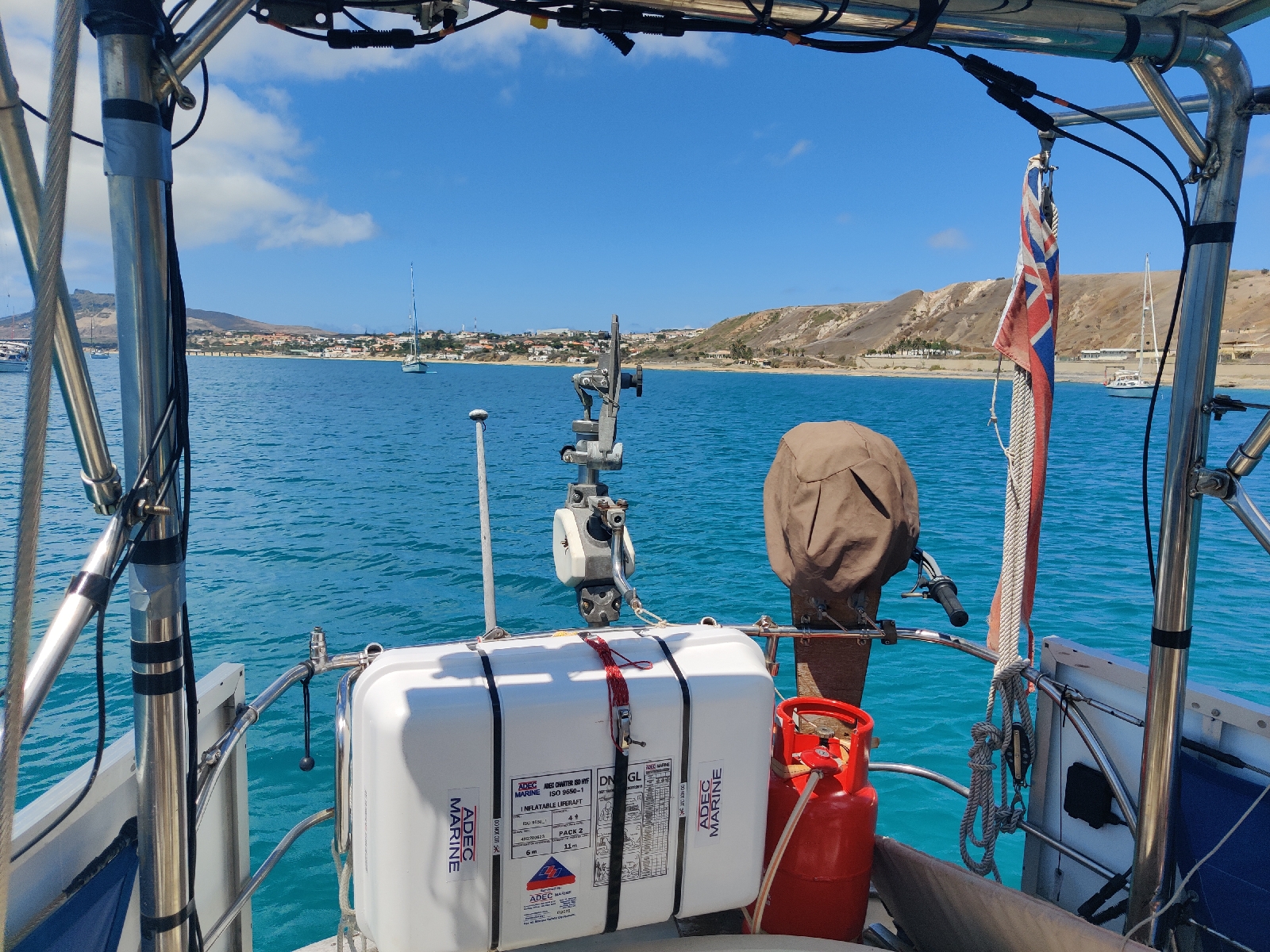
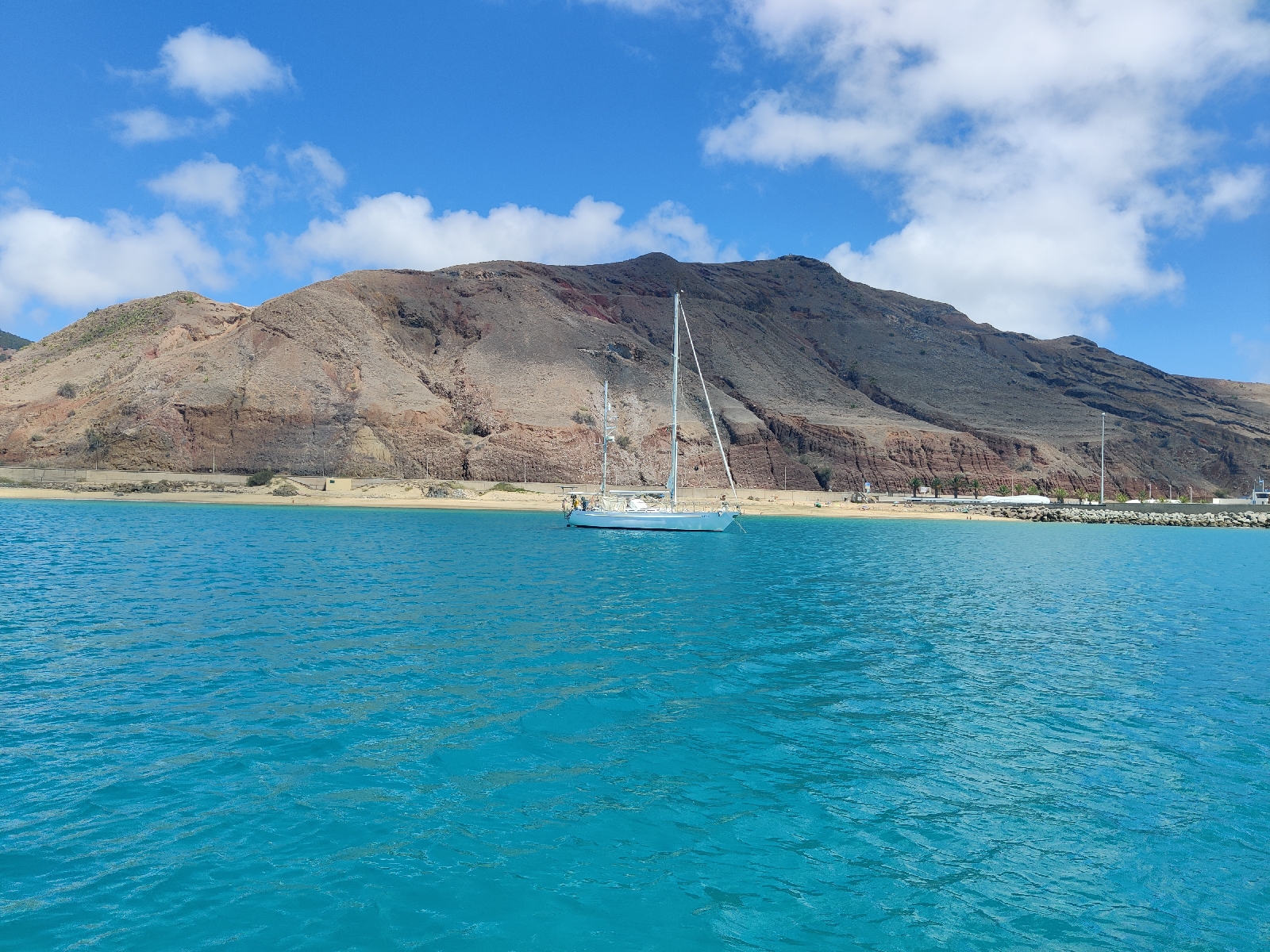

Time for a beer!