Tuesday, 14 May 2024

To Bermuda 6: A strange thing happened last night....

..... for the first time time since leaving Madeira it was cool enough to require, not just 1, but 2 lightweight covers over me. Admittedly, I was continuing my newly aquired habit of sleeping in the cockpit rather than down below, but nevertheless it was a startling development. On previous nights I had been quite comfortable with one. 

On being forced down below by daylight breaking at around 0530, I also found the pilot berth, which previously was too warm to sleep in due to its height and being out of the through-draft, was now a most comfortable bed once again!

I suspect this coolness may be a temporary phenomenon brought on by the current northerly winds and rather less the result of the few hundred miles of northing we've made since leaving St Martin. Yes we've left the tropics, but we're on the same latitude as southern Florida!

I dozed until about 0930, roused myself and did the washing up from the previous night and even had a shower. Yes that water was cooler too. Then I caught up on messages and the news headlines and downloaded a new GRIB (a computer file containing a weather forecast in graphical form) thanks to the wonders of Starlink. 

My Dad would be appalled. A busy GP he loved weekends and summer holidays on his boat with the family, even if it never left the mooring, because no one could ring him. The world would just have to wait until he got back home. Mobile phones would have been an anathma to him, but if he couldn't even have escaped in the middle of the bloody ocean, goodness knows what he would have done? Not that he ever wanted to get anywhere near the middle of an ocean on a small boat. The middle of the Solent was quite far enough thank you!

However, thanks to the latest grib I could see we had another 48 hours or so of lightish headwinds veering slowly towards the East which meant I could leave everything well alone. The Hydrovane would take care of everything. As the wind veered it would keep the boat at the same angle to it and without me lifting a finger we'd be steering the best possible course given the wind and our destination. 

Until that is, that it veered so much that we headed off to the east of the island. All I needed to do then was change the vane's angle to the wind and adjust the sails accordingly.

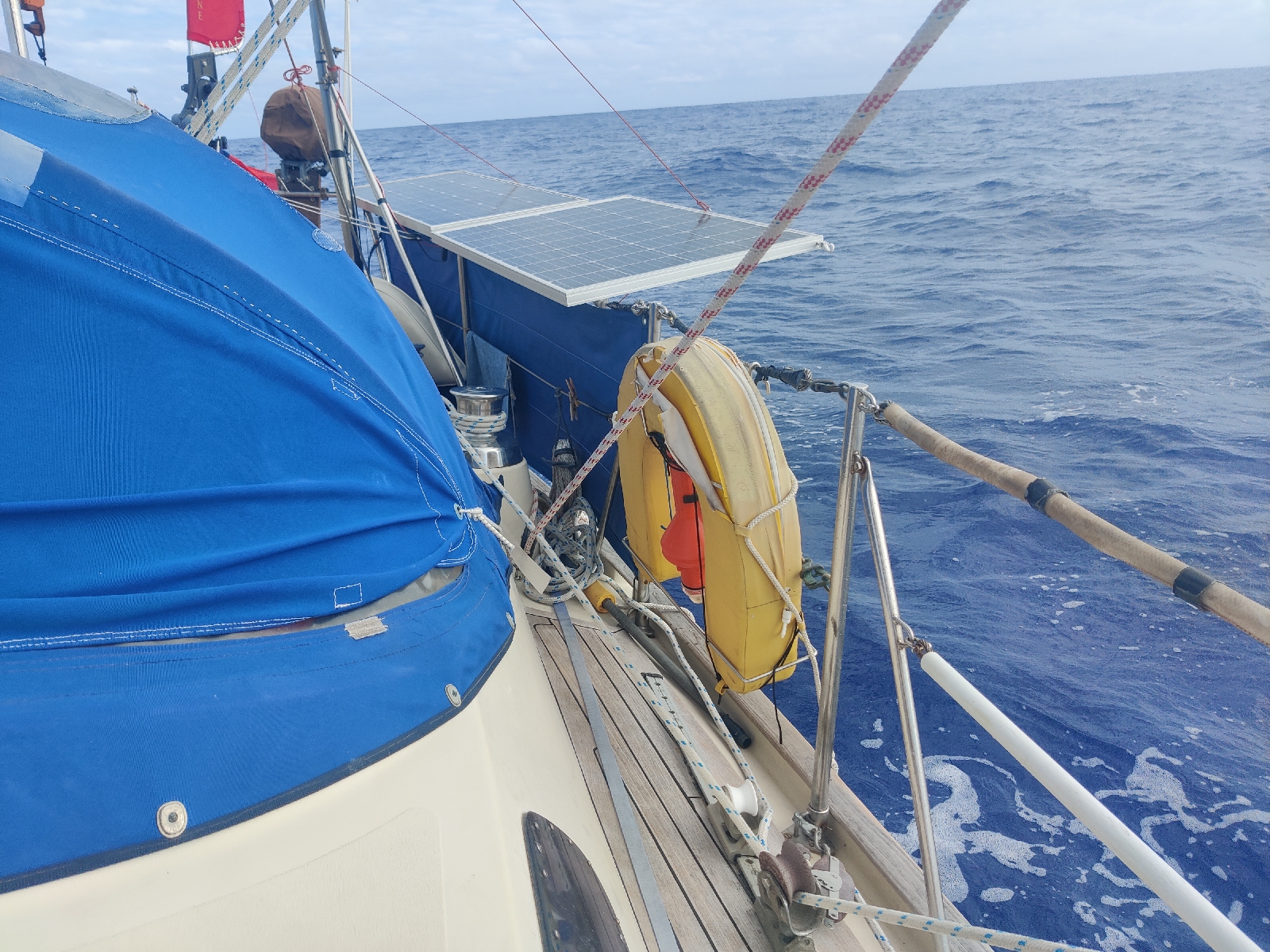
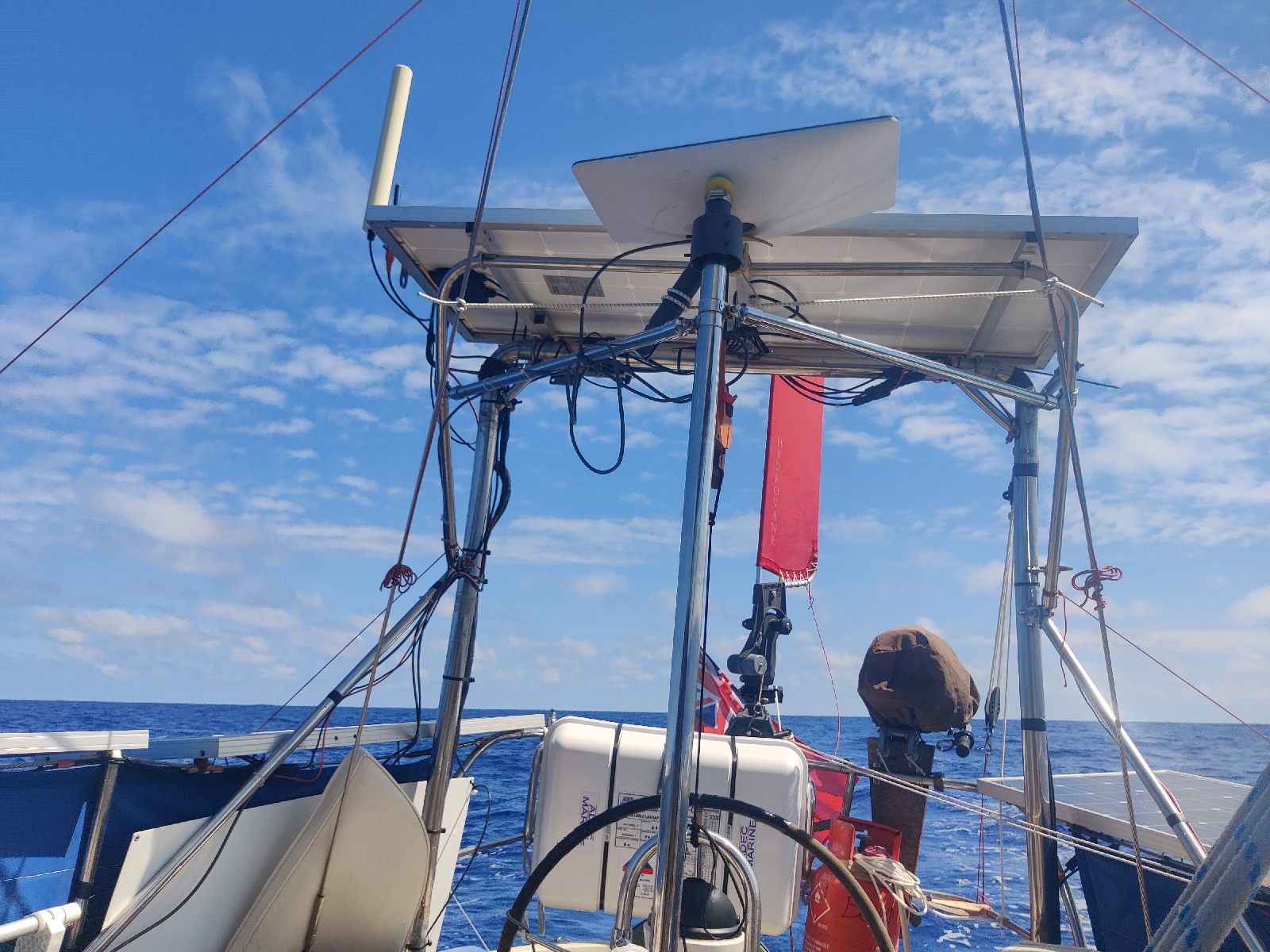
That red thing is the wind vane. When the boat's angle to the wind changes it moves and through a clever system of cogs and bearings, turns a rudder in the water that put's the boat back on course (relative to the wind)

And so the day slid almost effortlessly by and Bonny, once again under her slutter rig, slid pretty effortlessly through the North Atlantic Ocean in a roughly north westerly direction at around 3-4 knots.

Around 1000, I tried calling up my Swedish friends Jan and Elli, some 10 or so miles ahead of me on ther boat Titt4, but got no response. Then at about 1400, Elli responded to my call. They were about 7 miles away at that point. We had a pleasant chat and both parties were pleased to hear the other was fine. We agreed to try and make contact again at our previously agreed chat time of 1800. I made this attempt because by 1800 they may be out of range.

As at 1655, we are 342 miles from Bermuda, so we're about 60 miles closer than this time yesterday, which is 10 miles better than yesterday. At least we're getting closer!


Monday, 13 May 2024

To Bermuda 5: A Curate's Egg and other things

At around 0115 this morning I was woken from my slumbers in the cockpit by the sensation that the boat bouncing up and down rather more than it was moving forwards. One of those strange ocean phenomena, the wind had died away to almost nothing whilst at the same time the previously, almost flat surface of the sea, had turned into a vicious little chop. The combination of the two does not make for a comfortable bed!

Oh well, time to motor again. I started the engine. It died within seconds. Oh, oh, have I pushed my luck too far? I tried again. It took some time but eventually settled down to its normal rythm. Next, drop the slutter jib, furl the genoa and sheet the main in tight, lock the hydrovane, set a course on the autohelm and chunter onwards in a northerly direction at around 3 knots.

Then back to dozing in the cockpit until a shower forced me below at around 0300. At some point the sea stopped being so lumpy. 

I slept on and off and to my relief, except for occasional falters, the engine behaved itself. I'd already decided to take the lazy approach to dealing with it - hope that it gets me to Bermuda. Once I start fiddling I might make matters worse or at least that's my excuse!

Around 0830 the wind returned. That was good of course. Less helpful was that it was from around NNW which meant we couldn't lay Bermuda but had to head NEish. The forecast was that it would veer north this evening and then east of north during the night, so heading NEish now seemed a good idea. Then a lengthy debate took place amongst the crew.

Should we point as close as possible to the wind or free off a bit and go faster? Quite why a debate was nessary I've no idea. I know that in lightish winds you make more progress by going the long way round but faster. It's a bit like taking the B road directly to your destination or taking a detour on the motorway. It's a no brainer isn't it. So I didn't. I hardened up and in the process had to drop the slutter jib, because hard on the wind it just got backed by the Genoa. 

On we ambled pointing as high as possible going slowly and making more leeway as a result (the sideways movement of the boat as it goes through the water). Result, the boat's course over the ground (COG) was actually worse than if it were pointing another 5-10 degrees away from the wind.

After a few hours the penny dropped, I fell off the wind a little, eased the sheets and re-hoisted the slutter. Result: speed up half a knot + and COG better by 5 degrees or so. 

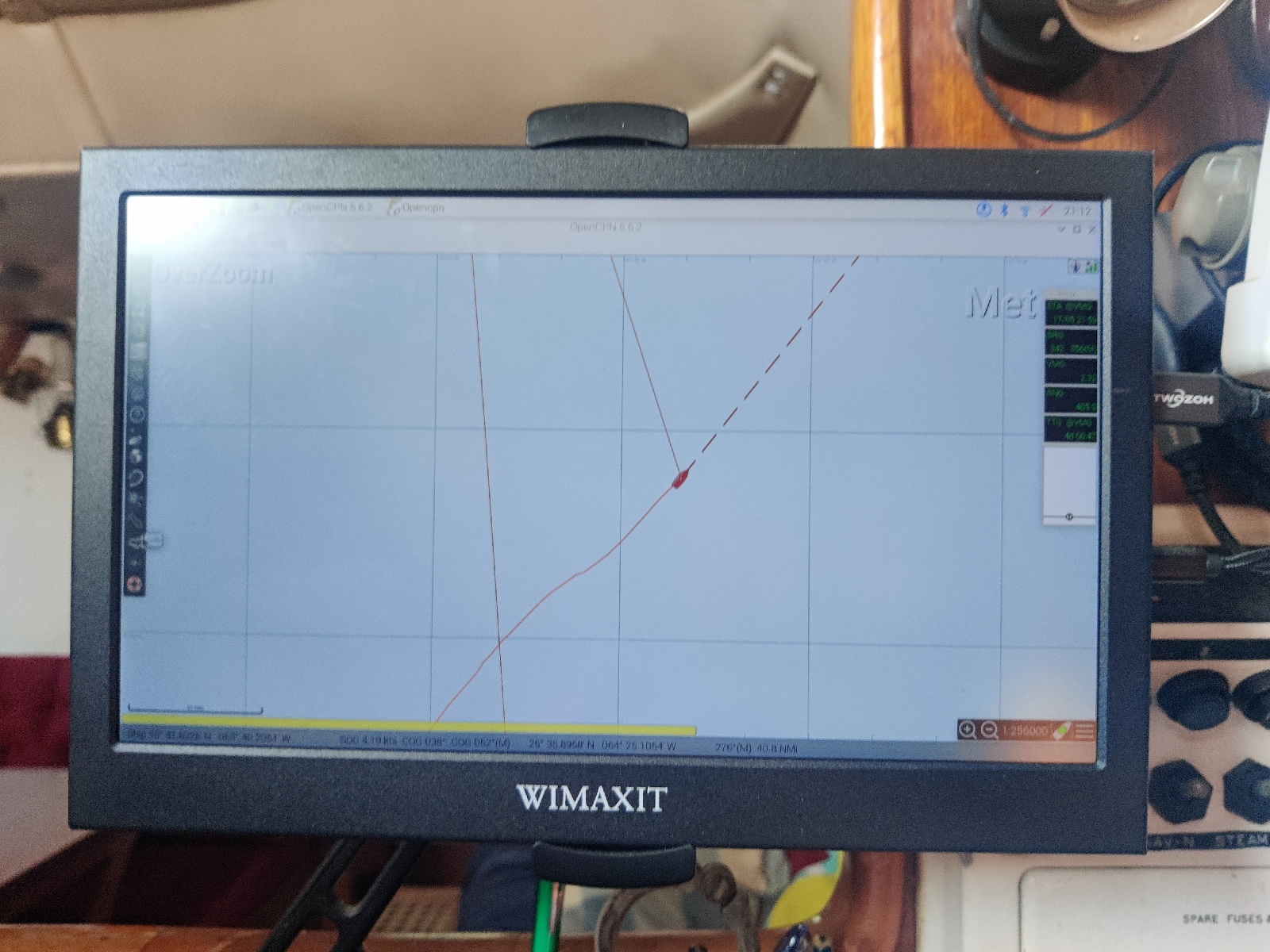
The kink in our track in the photo below shows the effect.

The left most, near-vertical red line is part of the direct route from St Martin to the south and Bermuda to the north. The line with the kink is our track. The dashed red line is the boats heading and the other red line going up from the boat icon is the direct bearing to Bermuda.

Everyone knows you can't teach old dogs new tricks, but it seems this old dog can't even remember the old tricks he's already learnt.

For those who may be interested - a few  domestic photos....

First an overview of the galley complete with restraining bar that I use to wedge myself in when the the boat is either leaning a lot to starboard or is generally getting flung about. It provides just enough space for me to turn around if I bend my knees. I find it invaluable but it's no good for those with a wider girth!

Next, a close up of the draining board area complete with now worn out drainer that Mick found in the Canaries. Its proved invaluable. 


Once it's full of washing up one simply sticks it out in the cockpit to dry or get an extra rinse subject to the weather!

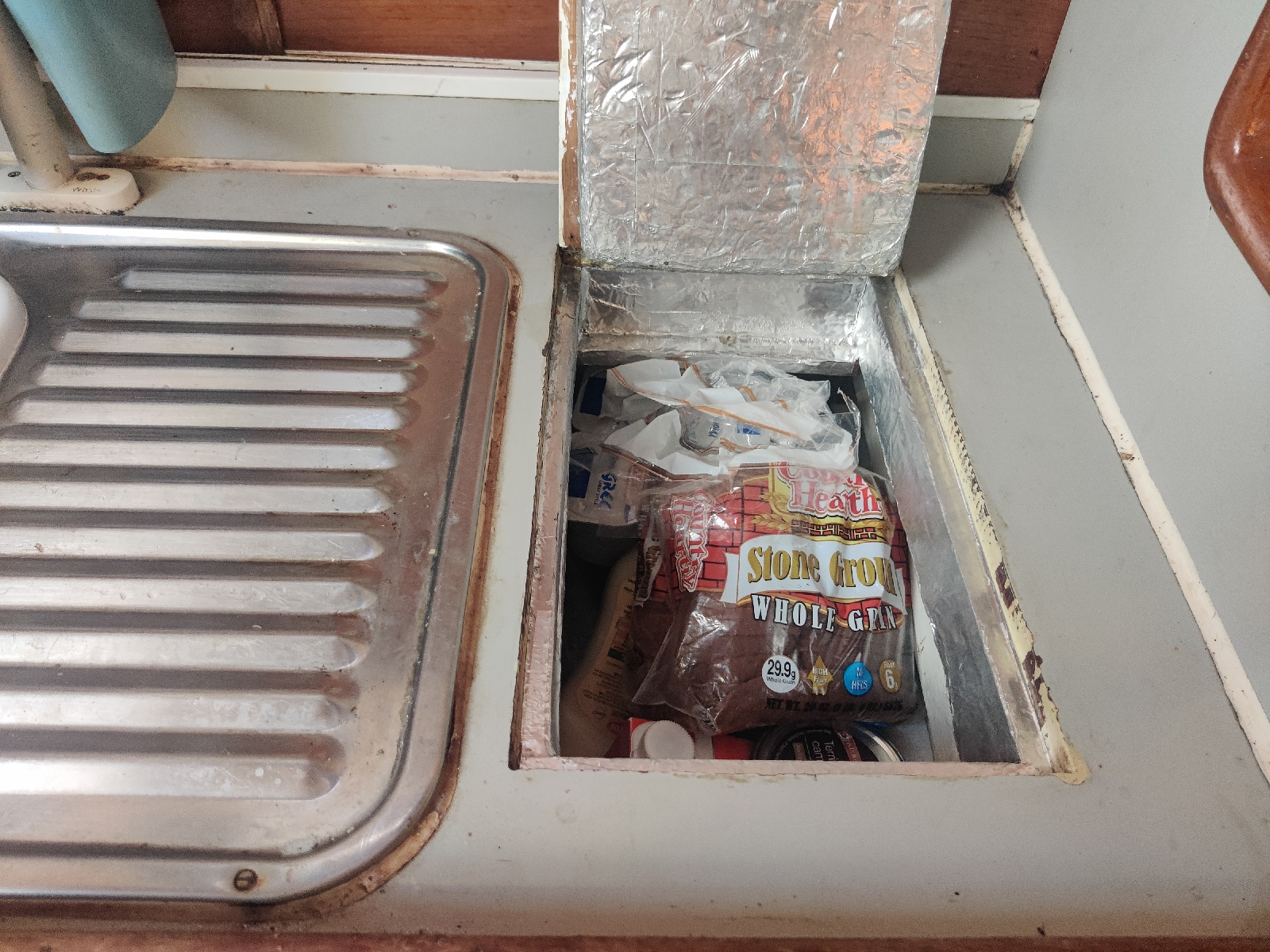
Underneath the home made wooden draining board which lifts off is the fridge trap door...

...giving access to the top loading home made fridge box which extends underneath the stainless steel draining board. A bit of a pain to find stuff, but it stops the cold air from falling out!

Anyway we've continued slowly North Easwards for most of the day, sometimes touching 5 knots but mostly around 3 - 3.5.

As of 1645 local time (BST-5) we have 404 miles to go so we're only about 50 miles closer than around this time yesterday! 

I'll probably have to tack NW later if the wind behaves as forecast.

Sunday, 12 May 2024

To Bermuda 4: 3.5 wheels on my wagon.....

That's to say we've been sailing once again, since about 1800 yesterday (11/5) evening when a light breeze filled in from the East and I finally released the cruising chute from its sock, switched off the engine and slid along gently at 2.5 - 3 knots during the night. 

I slept in the cockpit once again which once again was most pleasant. The only disappointment being I didn't see the northern lights that apparently had been seen as far south as the Behalmas! The fact that I was facing south except for my hourly checks on the course and for shipping may have had something to do with it!

Talking of shipping, I completely forgot to mention my close encounter with another yacht yesterday morning when I was in the middle of changing the sails. I had noticed her on the AIS for the previous 24 hours slowly gaining on us from the south, and by about 0900 yesterday, Panacea, a French boat was almost within shouting distance. Once I had finished  faffing about with miles of bits of string, I called her up on the VHF and we had a quick chat. Not surprisingly, they too were bound for Bermuda. They had also just run out of wind and were now motoring until they found some. At that stage, with the exception of an exceptionally bright yellow land bird the size of a sparrow, I had encountered any other living things.

The bird lingered for a while and then flew off, too quickly for me to get a photo. I rather fear he or she was very lost and most probably destined for a watery end. The nearest land is the Behalmas, a couple of hundred miles to our West!

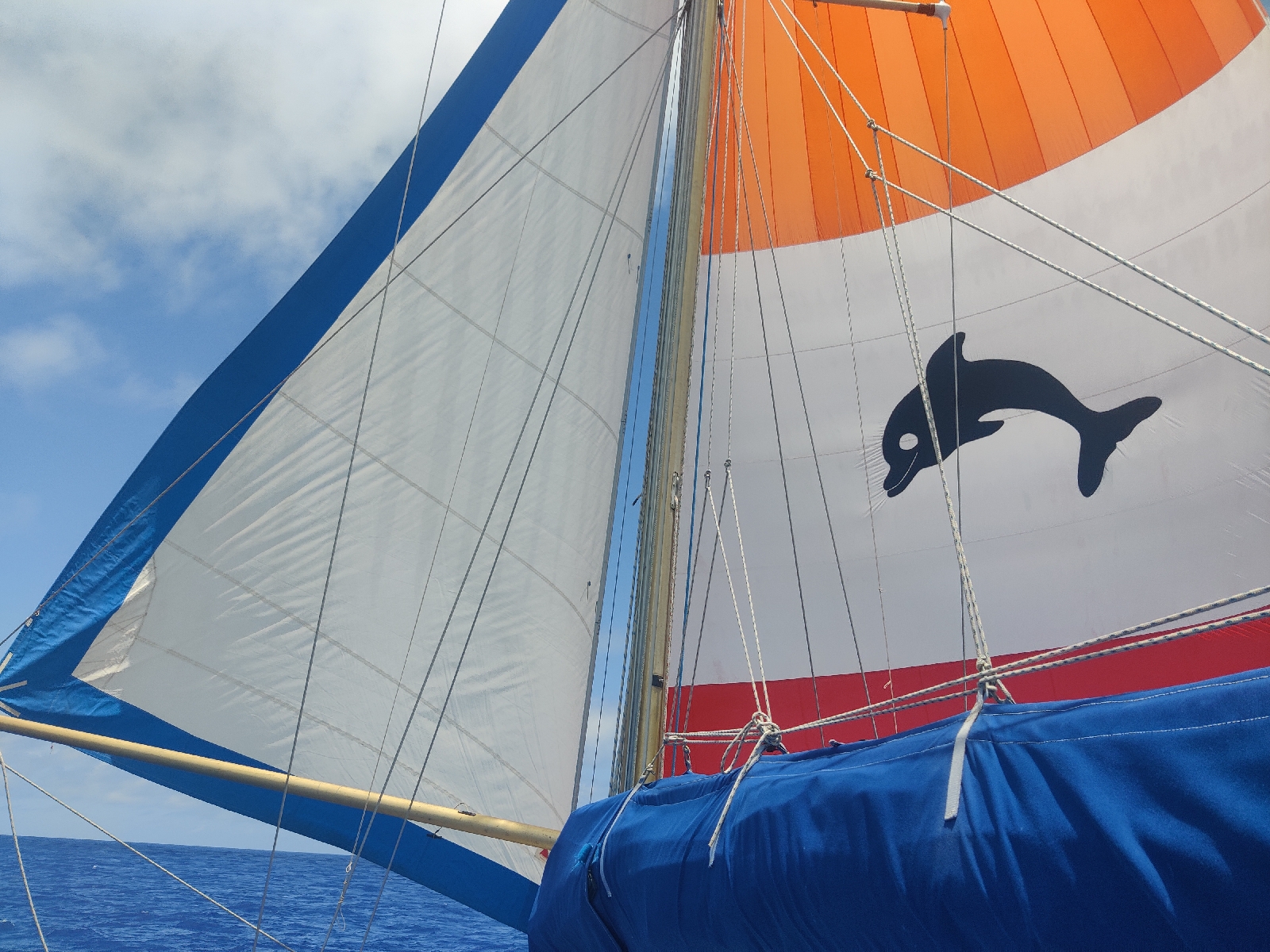
At some point during the early hours of this morning (12/5) the wind did finally move towards the south, which meant that in order to stay on course we brought the wind further aft, allowing the genoa to be polled out to windward with the cruising chute (no pole) to leeward like so ....

...except that is, at that time, the sails were the other way round with the genoa to starboard rather than port.

My hourly sleeps must have worked pretty well because I was always asleep when the alarm went off. At around 0530 the dawn woke me and I moved my bed back down below. 

When I checked on things at about 0730, it was clear that the wind had moved further south which meant that to maintain our course I would have to gybe the boat so that the wind came from the port quarter rather than the starboard. 

This was quite a time consuming business.....

1) Run the pole guys for the second pole from the bow to the stern through their various  blocks on the port side

2) Douse the cruising chute and lower it in its sock onto the deck

3) Attach the guys and set up the second pole to port where the cruising chute had previously been.

4) Furl the Genoa

5) Unfurl the Genoa onto the port pole

6) Un-rig and stow the 1st pole in its foredeck hand hold position.

7) Remove the port masthead halyard from the cruising chute's head and make it up on the mast, attach the starboard side masthead halyard to the cruising chute's head and re-run the clew line from the port side cockpit block and winch, down to the block and winch on the starboard side of the cockpit.

8) Hoist the cruising chute up the mast in its sock.

9) Pull the sock up to the top of the mast and make the hoist line fast so that the sock stays up there

10) Get back down to the cockpit and haul in on the clue line to set the sail before it wraps itself round the forestay!

Two hours later, hot, sweaty and tired, but with the boat sliding along northwards nicely, at 3.5 to 4 knots, it was time for breakfast! Museali with yogurt, juice and coffee; again!

Then I wrote the above. Next, time for a nap in the forpeak where the down draft from the cruising chute keeps the temperature deliciously cool...

It's a tough life! 

Then I cooked for the first time - a veggie curry for later.

We're currently (1530 ish on 12/5) slipping along nicely under cruising chute and poled out genoa on port tack and a beam reach. Now we're flying - 4+ knots with 483 miles to go.

This evening before dark, I'll probably have to douse the cruising chute and replace it with the mainsail, given that slightly stronger winds are forecast.

Hmmm, the engine...!

Saturday, 11 May 2024

To Bermuda 3: One wheel on my wagon and ....

Well, more accurately, the wind finally died at around 1100 this morning local time, just after I had spent one and a half hours making a sail change to take account of an expected following light wind! That involved dousing the extra jib and hoisting the cruising chute and rigging one of the poles to boom out the genoa. The number of bits of string involved defy belief and it takes ages on one's own.

So, at the time of writing (1700 local time on Saturday) we're motoring at around 3.5 knots roughly northwards. There's the barest hint of a breeze from the East (even though the forecast says it should be from the South) but it's not enough to fill the lightweight cruising chute which is currently dangling from the mast head in its bright red sock for when the breeze does finally arrive...

On top of that, the engine is not on top form. It keeps faltering. So far it has always recovered, but for how long will it continue to do so? I suspect either dirty fuel was taken on in St Martin or there's water in the fuel. Either way, I think the first steps will be to check the oil/water separator and change the fuel filter, but it's just too dam hot and while its still going I think it's best to keep going north where tomorrow I should find some wind. If I'm lucky I'll get a nice gentle breeze tomorrow and can check out the engine while we sail along without getting thrown all over the place.

Last night was very pleasant. I 'slept' outside in the Cockpit under the stars. Whilst I didn't actually sleep until after 0200 it was a lovely sensation to be gliding along with the water gurgling down the side of the boat and the through-drafts from the sails keeping me cool. I even needed a light cover!

Not much else to say just now except that the sky has clouded over a bit and so I can sit in the cockpit without roasting!

Oh almost forgot, 556 miles to go (at 1730 local time)!

Friday, 10 May 2024

To Bermuda 2: Strategy, Decisions, Tactics and a Slutter

As forecast the winds eased in the early hours of the morning (10/5/24). I had a surprisingly successful night of sleeping and waking every hour (until 0500 when I enjoyed the luxury of 2, 2 hour spells of sleep). 

When I finally got up around 0900 I knew it was decision time, actually that was at about 0200 the previous morning, but I couldn't be bothered to do anything complicated like making decisions then. The decision was whether to alter course significantly to head north west in search of stronger winds or to carry on heading more or less directly for Bermuda in the now gentle breeze of about 10 knots (and due to ease further). A longer route with (eventually) stronger winds and therefore faster speeds, or a shorter route at slower speeds? 

Just about the only certainy in the equation, was the distance to Bermuda, about 700 nautical miles. The weather system is not particularly stable at present and it is quite possible that a diversion to the north west may take much longer than expected to deliver the stronger winds. Conversely the winds between our present position and Bermuda could turn out to be lighter (or stronger). That I had any idea at all, was thanks to Starlink working pretty well and so I am getting up to date weather forecasts.

I decided to head NW and then an hour later, changed my mind and returned to the direct course to Bermuda. Going looking for wind would mean going slower until I found it because, with the wind just north of east the relative wind speed would be slower. A more northerly heading would increase the relative wind speed and therefore the boat's speed. We're talking about a small difference in the 5-10 knot wind speed range but that makes a 'big' difference to Bonny - maybe half a knot of boat speed in the 3-4 knot range.

Next challenge - more sail was needed, but Bonny is a sloop and only has one headsail. Ah but, what about trying the 'slutter' experiment again? Bonny has an emergency forestay, the bottom of which can be attached to an eye on the foredeck (the top is fastened permanently to near the top of the mast - I hope) and this can be used to attach a second headsail. I had one and Mick and I had tried it without much success once before - it simply got backed by the genoa and achieved nothing, but I thought it would be worth trying again. Perhaps the wind angle was different this time. Anyway, it would get me off my backside.

So began a couple of hours of playing around with bits of wire and string to try the idea out. 

To my surprise it seemed to work pretty well. 

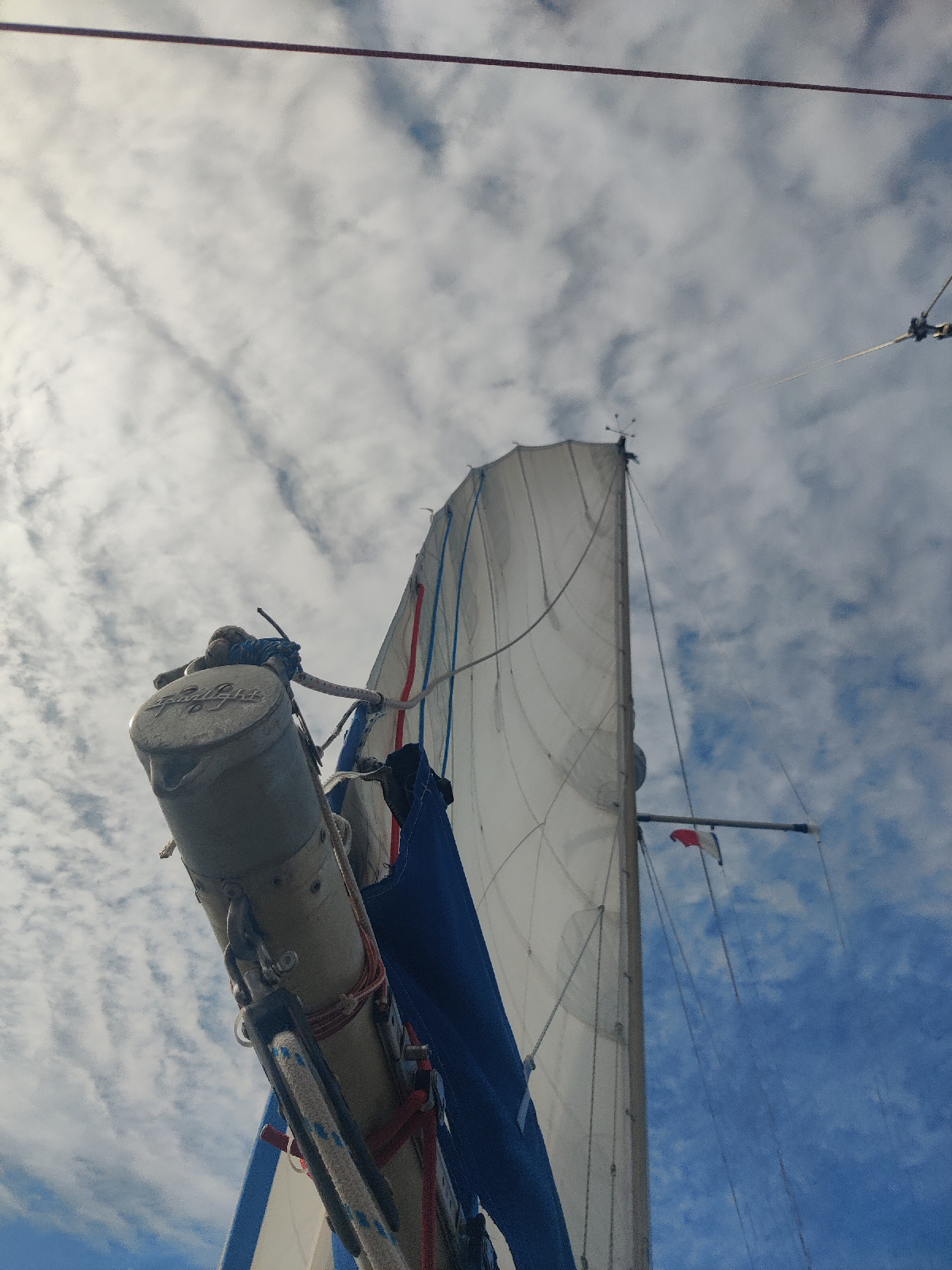
The photo above shows the theory in action, now there are two 'slots' rather than one. One between the mainsail and the added staysail and the other between the staysail and genoa. The slots produce 'lift' and help pull the boat forward.


I managed to find a better position for the deck sheet block - further inboard than before....

... it's where the red and white line attaches to the deck. Previously it went through the white 'car' further forward and further out.

The dail is also sheeted inside the mainmast's upper stay rather than outside. These two changes have increased the space between the outside of the temporary sail and the inside of the genoa and provide just a big enough slot for both sails to fill....

It's not perfect but I'm pretty sure it's helping.

By the way, for those unfamiliar with sailing vocabulary, the term "Slutter" is a curruption of "Cutter". A cutter is a sailing boat with two headsails attached to two permanent forestays. A "slutter" is the term for the rig described above. Quite why, I'm not certain.

I also 'rigged' one of the spinnaker booms down the middle of the foredeck to provide something extra to hold onto. Not particularly necessary in the present conditions, but will be useful in more boisterous weather - which is when I'll need to douse the extra jib.

I also made a further refinement to the rig for light wind sailing and moved the mainsheet car up to windward to increase the curvature of the mainsail. This increases the power produced by the sail. At least that's what the books say!

I'm pretty sure these refinements are having a postive effect because we're making about 3.5 knots in about 7 knots of wind, which is as good as I think Bonny has ever done!

By the way, I have my good friend Bernie Branfield to thank for suggesting the slutter and spinnaker boom refinements.

We passed our second 100 mile waypoint earlier this afternoon and at the time of writing (1540, 10/5/24) we have 640 miles to run!

A further innovation has been to the attachment of the Starlink dish. I've positioned it so that it's more or less horizontal. 

This has improved it's view of the sky and got rid of minor obstructions caused by the back stays. This has got connection times down to 20 minutes. It is of course very calm weather at present and it's unlikely to be so good in rougher weather.


Thursday, 9 May 2024

Next stop Bermuda

Bonny is now (9/5, 1200 local time) en route to Bermuda having departed Marigot Bay, St Martin, around 1300 on 8/5, in driving rain, grey skies and gusty winds.

A major, unexpected and disappointing change of crew has unfortunately been forced upon the ship, which has sailed without her stalwart 1st Officer. Mick encountered a health issue during our stay in St Martin and was advised by a local GP not to undertake a lengthy sea passage without a diagnosis, which may of course, indicate the need for urgent treatment. It would take at least three weeks to get one locally and with the start of the hurricane season fast approaching on June 1st, I could not risk such a delay. 

Mick therefore flew back home yesterday in order to get the ball rolling there. Our new Canadian friend whom we bumped into during check-in, nearly three weeks ago, cooked us both a farewell breakfast yesterday and then took Mick ashore for his flight. Poor David got more than he bargained for though, because his new but temperamental outboard motor failed to start. He therefore had to row Mick the half mile to the town dinghy dock in the pouring rain! Mick and I, having already stowed Bonny's dinghy. That was a two stage process; we hauled it on board and cleaned the bottom and washed the sludge out of the interior on Tuesday evening in heavy rain and then got it packed up yesterday morning in a short interlude before the rain returned.

On Monday evening Mick and I hosted a farewell dinner on board Bonny for Jan, Elli and David. Mick cooked a wonderful salmon dinner which was enjoyed immensely by us all. I fear the level of culinary expertise will drop a few notches in his absence!

David dropped me back on board Bonny after breakfast, and a couple of hours later, I followed Titti4 (Jan and Elli) also bound for Bermuda, out of the anchorage and set sail, initially with one reef in the main and a few rolls in the genoa. However, within a few hours the wind increased to an estimated 25 knots from the East/East NE and so another reef went in the main.

The rain was absolutely torrential for quite some hours, making the constant trips backwards and forwards to the chart table to check our position as we skirted the islands and shallows to the west of Anguilla, something of chore, with my sodden lightweight shower jacket having to be removed constantly and my arms and hands dried off before operating the computer/chartplotter mouse. Then repeat, repeat, until clear of the shallows.

Titt4 is a bigger boat and perhaps sailing 3/4 knot faster than Bonny. Therefore whilst we had her insight all yesterday and this morning, she has now disappeared ahead over the horizon. We may still be able to talk on the VHF this evening however.

Progress has been reasonable during the first 24 hours, with just over 100 miles covered and with 755 miles to go to Bermuda.

Greeted by a delightful sunrise this morning...


Wednesday, 1 May 2024

Life in Saint Martin has been.....

Hot, sweaty, windy, rainy, choppy, and sociable, and finds the crew pre-occupied with boat jobs and the weather.

We've been here over a week now and there's every prospect we'll be here for another week. St Martin was our chosen island from which to depart the Carribbean for Bermuda (although it is possible we may visit Anguilla (only 5 miles away) and Culabra, one of Puerto Rico's Spanish Virgin Islands lying to her East, before we finally depart).

We're here now (end of April), because June is the start of the Hurricane season and the north west Carribbean lies on the arc that most hurricanes travel as they develop in the mid Atlantic before sweeping south west as early stage tropical depressions, through west, north west and eventually north east as fully fledged hurricanes; when they typically ravage the northern Carribbean islands, Cuba, the florida coast and the Bahamas, before, usually, disappating.

So we want to be out of here before the first hurricane arrives. But we also want to avoid the northerly gales that have a habit of sweeping down the North American Atlantic seaboard in the winter and spring. The later we leave, the less chance of encountering one of those, but the greater the chance of an early season hurricane! That's why I decided to buy Starlink - we'll now be able to track the weather systems in real time and take avoiding action if necessary. 

We chose Saint Martin because it has well stocked Chanderlries for boat stuff and extensive marine services and is therefore a good place to prepare the boat for the ocean passage to Bermuda, about 800 miles to the north - roughly half way to our destination, Nova Scotia.

On arrival here, we added two big jobs to our jobs list, which, until then, mainly comprised routine maintenance and checks. The two additions being to repair one of the burners on the gas stove, which had finally become unusable due to corrosion and to try and cure a major condensation problem around the fridge box I made and installed a couple of years ago.

Today (Tuesday 30th April) feels like the week or so just gone, has been full on tackling these two disrupters to easy living.

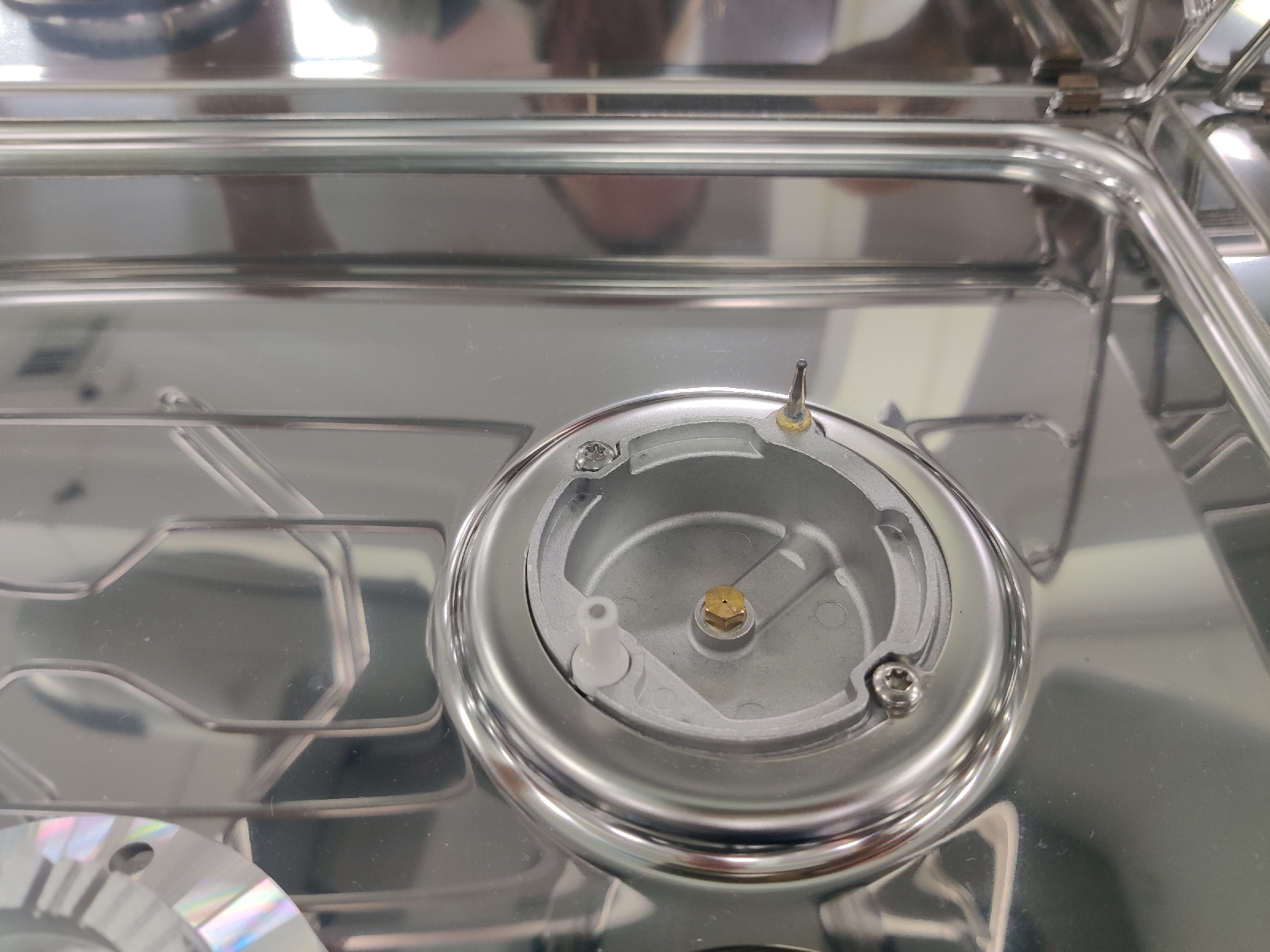
Bonny's gas cooker is an old Plastimo, a brand apparently reknown for its propensity to disintegrate in tropical climates. It's lived up to that reputation (I really need to replace it but can't afford to). Indeed, the warning signs were apparent way back in the Canaries, when one of the burners became increasingly difficult to light. I managed to dismantle it then and removed lots of debris that was preventing air getting in. That lasted for a few months but it deteriorated again until finally a few weeks ago it became unusable. So we took it appart again....

The lip on the burner cap had now corroded so much that too much air was getting in which made flame very unstable. 


All we needed was a replacement burner cap, but none of the 3 large chanderlries on the island stocked the type required. Another type was available but that would require fitting a new flame spreader too. They, off course were designed to fit a different shape cooker base plate, one with a void under the burner spreader....

However, we had little choice but to try and make it work. Some $40US later we had the bits we needed.

Next step, remove the old burner spreader. Unfortunately my repair back in the Canaries meant I had to butcher the old spreader to get it off before we could replace it with the new one and its burner cap.

Initial trials were not encouraging. Instead of a nice blue flame we had a smokey yellow one. At this point we realised that with no void under the new burner spreader, which, unlike the old one, sat directly on the base plate rather than being raised above it, hardly any air was getting in. Perhaps we could cut away some of the bottom part of the burner spreader to allow air in?

We also needed a means of securing the burner spreader to the base and we needed a base that was wider than the existing one. Fortunately we had the tap set bought in Mindelo and were able to drill and tap a hole in the base and then bolt the burner spreader to it. I also managed to enlarge the base with an old tin end that I had previously used in a vain attempt to make a replacement burner top (thats why it looks so crappy). Eventually this will need to be replaced with a more robust piece of metal....

Hey presto - it worked...

œ

Next up, the fridge - although in reality we tackled these two jobs in parallel.

We were first alerted to there being a problem when we noticed that even after we had fixed all the pipe leaks following the installation of the new water pump, water was still collecting at the bottom of the locker under the sink. Then I noticed that the bulkhead on the forward side of locker was saturated. Fortunately, when I installed the new fridge and it's compressor I had drilled a hole through thies bulkhead in an attempt to provide more ventilation to the compressor and I was able to see the saturated plywood and by inserting my fingers through it, could tell the water source was from above - from the fridge box. 

There was nothing for it but to dismantle the new front panelling in front of the fridge box ...

and look for the source of the water. This also involved dismantling the new galley work top I had built in the Canaries and removing the bilge pump.

Once done and the front panel removed it was clear what the problem was; condensation. It was forming on the outside of the plywood fridge box and running down the sides, collecting on the base and then running down the bulkhead.

Why? As Mick explained patiently, because I had not bonded the insulation to the box. Water vapour in the air gap was therefore able to condense into liquid water on the cold surface and dribble down the sides of the box!

Bugger! To fix this I would have to: remove the cold plate and disconnect the gas tupes between the compressor and rhe box; remove the fridge box and existing insulation; cut away the joinery around the front of the box so that it (the box) could then be slid in to the gap with the insulation attached; bond the insulation to the box, replace the box, reinstall the cold plate and gas tupes and replace the top insulation and lid. Previously, I had simply inserted the insulation boards in place underneath and around the sides and then pushed the box in between the insulation boards. 

I knew I would have to cut out the top insulation that was glued in, whereas that around the bottom and sides was not and could be re-used. So, the first job was to buy some more insulation and glue. That took the best part of a day.

Then I had to remove the cold plate and delicate pipework. Then remove the box and insulation boards. Then cut away the surrounding joinery. Thankfully a new pal, David, a solo sailor from Canada, lent me his multi tool, this made this a much easier job than it would otherwise have been. 

The front panel I had made when I undertook the original installation, wasn't wide enough to cover the full width of the box plus insulation boards glued to both sides. This meant that the insulation on one side of the box could not be glued on before inserting the box. The glueing operation took a couple of days because of the need for the glue to set before manhandling the box back into place. Our portable fridge/freezer box and the cover panel came in handy as a weight to press the insulation boards onto to the sides of the fridge box..

Next step was to slide the box back into its slot having first inserted a sheet of insulation board on the left behind the surrounding woodwork. That board I secured in place by the very primitive means of jamming a thinner sheet of insulation board alongside it.

Once that was all done I stood back to admire my handiwork. Hmmm, something was not quite right. Dam and dam again. The whole thing stuck out an inch further than before which meant there was not enough space in which to fit the front insulation board. This was a disaster. The objective of the whole operation was to improve the insulation not reduce it. The box was now jammed in so tightly that I was sure any attempt to remove it would rip the insulation boards off the bottom and right hand side of the box and would necessitate the destruction of the insulation boards I had just jammed in so tightly?

What to do? Then it occurred to me. Simply line the inside of the front of the box with insulation board. Sure it would make the box a little smaller but that was a small price to pay. Also, I could cut the existing board in half to reduce its thickness and stick half of it on the front of the box before covering it up with the front panel.

The fiddliest job was insulating the top of the box around the lid. Achieved by crudely stuffing in bits of board into the various voids and bond them in with gunk. Then I covered the whole area with aluminium tape ...

The fridge is now back in operation and so far there doesn't seem to be a problem with condensation.

On the social front. We discovered on our second full day, that Rob, whom we had first come across in Porto Santo and then again in Bequia, was still here. We had set out in our dinghy to visit the Dutch side of the  island via the Lagoon and came across Rob. Of course we had to stop to say hi. A few beers and Rums later he suggested we go and visit his pal Ian. That was the end of our planned visit to the Dutch side. Goodness knows how many rums later, we returned to Bonny to recover.

On our first day, indeed at check-in, we bumped into a friendly Canadian.  A couple of days later when we managed to sneak past Rob and Ian without being spotted we bumped into David again in onevof the Chandeliers on the Dutch side. He had bussed it down the island in search of a new outboard motor to replace his deceased one and was delighted to be offered a lift back. Of course we went
aboard his lovely Choye Lee 36 footer and helped him consume his stock of Gin! That cemented a firm friendship and we have spent time together on most days since.

Then the day before yesterday, our lovely Swedish friends Jan and Elli on board Titti4 arrived. They too are heading for Nova Scotia and so we will hopefully make the trip together. 

At the moment it looks like a suitable weather window may open up next week for the trip to Bermuda.